
Quadrilateral A
Loading the math board and drawing, please wait…
In collections
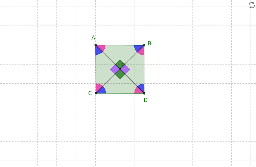
Is it a Parallelogram?
This example demonstrates how to determine if a quadrilateral is a parallelogram by dragging its vertices and explaining the answer using precise geometric terms. It uses GeoGebra commands such as point, segment, line bisector, and polygon. Suitable for middle school and above students to learn geometric concepts.
GeoGebra Commands & Parameters
Point(Circle[A, 5]) → BSegment(A, B) → aPoint(Circle[A, 5]) → CSegment(A, C) → bSegment(C, B) → cLineBisector(c) → dPoint(d) → DSegment(C, D) → eSegment(B, D) → fPolygon(A, C, D, B) → poly1, a_1, c_1, d_1, b_1Segment(A, D) → gSegment(C, B) → hIntersect(g, h) → EAngle(A, B, E) → αAngle(E, B, D) → βAngle(E, D, C) → γAngle(E, C, A) → δAngle(E, A, B) → εAngle(A, B, E) → ζAngle(B, D, E) → ηAngle(D, C, E) → θAngle(C, A, E) → ιAngle(A, E, C) → κAngle(D, E, B) → λAngle(B, E, A) → μAngle(C, E, D) → ν