
Quadric Surfaces by Osvaldo Choucair Vaz da Silva
Loading the math board and drawing, please wait…
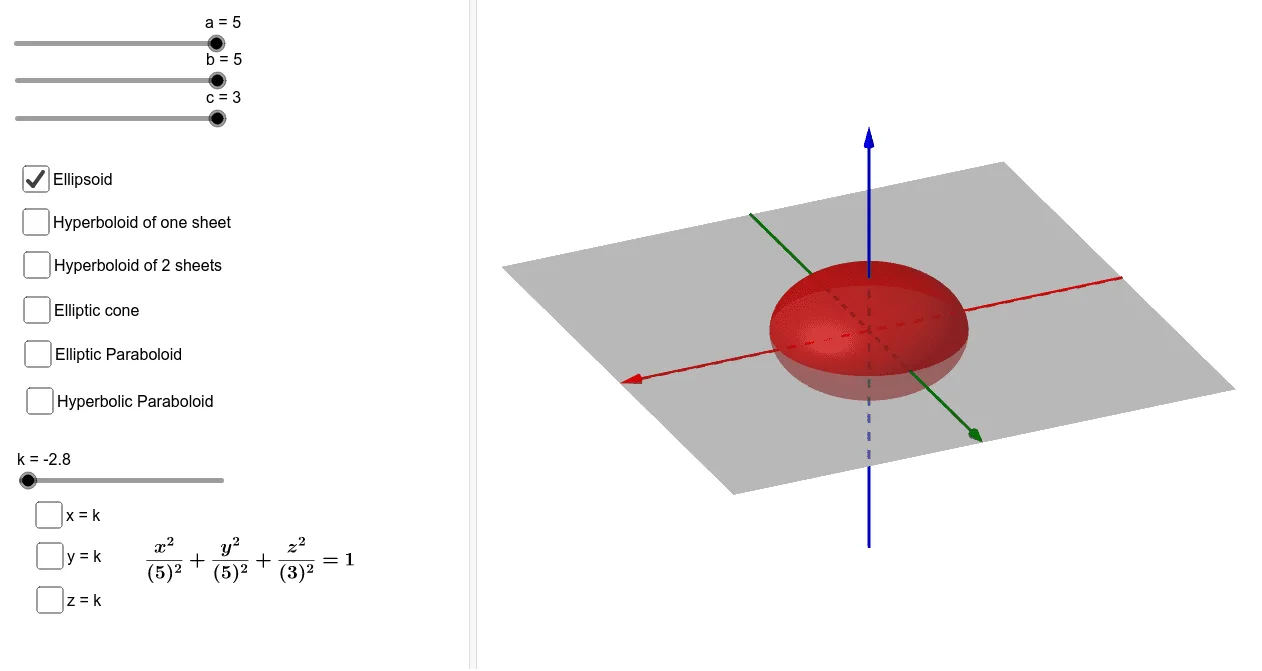
This example demonstrates various quadric surfaces such as ellipsoids, hyperboloids, and paraboloids. By modifying R Vozzo's original work, the specific equations for each quadric surface are added. It uses commands like IntersectPath for construction, suitable for high school or university-level solid geometry.
GeoGebra Commands & Parameters
IntersectPath(l, d) → qIntersectPath(n, d) → c_1IntersectPath(p, d) → d_1IntersectPath(l, f) → e_1IntersectPath(n, f) → f_1IntersectPath(p, f) → g_1IntersectPath(n, e) → h_1IntersectPath(p, e) → k_1IntersectPath(l, e) → p_1IntersectPath(n, j) → q_1IntersectPath(p, j) → r_1IntersectPath(l, j) → s_1IntersectPath(n, g) → t_1IntersectPath(p, g) → c_2IntersectPath(l, g) → d_2IntersectPath(n, h) → e_2IntersectPath(p, h) → f_2IntersectPath(l, h) → g_2
AI Drawing Prompt Reference
Create a 3D coordinate system showing several quadric surfaces, including ellipsoids, hyperboloids, and paraboloids. Use three mutually perpendicular planes (like coordinate planes) to intersect these surfaces, producing intersection curves that appear as ellipses, hyperbolas, or parabolas. Construction order: first draw the surfaces, then place the three cutting planes, then compute and highlight the intersection curves for each plane with each surface. The overall figure should clearly show the spatial relationships between surfaces and sections, suitable for solid geometry teaching.
The prompt above was compiled from the original drawing commands and is for reference only.