
Quadrature of a Cube
Loading the math board and drawing, please wait…
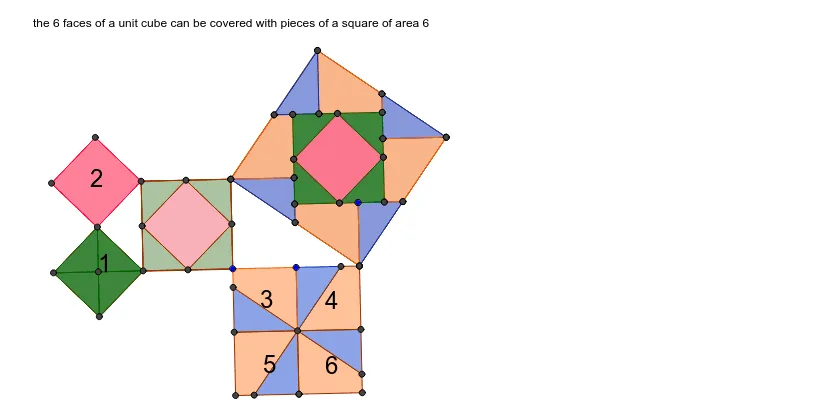
This example demonstrates how to cover a cube with a square. It involves the geometric properties of a cube and the problem of quadrature. Using GeoGebra commands such as Polygon, Line, Circle, etc., a series of geometric objects are constructed. Suitable for high school mathematics education and students learning solid geometry.
GeoGebra Commands & Parameters
Polygon(A, B, 4) → poly1, a, b, c, d, C, DPolygon(A, D, 4) → poly2, e, f, g, h, E, FPolygon(D, C, 4) → poly3, i, j, k, l, G, HPolygon(E, D, 4) → poly4, m, n, p, q, I, JLine(G, B) → rCircle(B, D) → sIntersect(s, r, 2) → KPolygon(B, K, 4) → poly5, t, a_1, b_1, c_1, L, MMidpoint(b_1) → NSemicircle(M, L) → d_1Midpoint(t) → ORay(O, N) → e_1Intersect(d_1, e_1, 1) → PPolygon(M, P, 4) → poly6, f_1, g_1, h_1, i_1, Q, RPolygon(P, L, 4) → poly7, j_1, k_1, l_1, m_1, S, TPolygon(K, F, 4) → poly8, n_1, p_1, q_1, r_1, U, VMidpoint(M, Q) → WPolygon(P, W, Q) → poly9, q_2, p_2, wPolygon(P, M, W) → poly10, w_1, p_3, m_2Polygon(W, R, M) → poly11, m_3, w_2, r_2Polygon(W, R, Q) → poly12, q_3, w_3, r_3Midpoint(c_1) → ZPolygon(N, Z, M) → poly13, m_4, n_2, zMidpoint(a_1) → A_1Polygon(A_1, N, L) → poly14, l_2, a_2, n_3Polygon(A_1, O, K) → poly15, k_2, a_3, oPolygon(O, Z, B) → poly16, b_2, o_1, z_1Line(D, q_1) → s_1OrthogonalLine(D, s_1) → t_1Polygon(A_1, O, Z, N) → poly17, a_4, o_2, z_2, n_4Intersect(s_1, b) → B_1Intersect(s_1, q) → C_1Intersect(t_1, h) → D_1Intersect(t_1, k) → E_1Polygon(D_1, D, A) → poly18, a_5, d_2, d_3Polygon(A, D, B_1, B) → poly19, a_6, d_4, b_3, b_4Polygon(D, E_1, G, C) → poly20, d_5, e_2, g_2, c_2Polygon(B_1, D, C) → poly21, c_3, b_5, d_6Polygon(D_1, F, E, D) → poly22, d_7, f_2, e_3, d_8Polygon(E, C_1, D) → poly23, d_9, e_4, c_4Polygon(C_1, J, H, D) → poly24, c_5, j_2, h_2, d_{10}Polygon(D, H, E_1) → poly25, e_5, d_{11}, h_3Vector(D, F) → uTranslate(D_1, u) → F_1Translate(D, u) → D'Translate(A, u) → A'Polygon(F_1, D', A') → poly18', a', f_3, d'Translate(A, u) → A'_1Translate(D, u) → D'_1Translate(B_1, u) → G_1Translate(B, u) → B'Polygon(A'_1, D'_1, G_1, B') → poly19', a'_1, d'_1, g_3, b'Vector(D, K) → vTranslate(E, v) → E'Translate(C_1, v) → H_1Translate(D, v) → D'_2Polygon(E', H_1, D'_2) → poly23', d'_2, e', h_4Translate(D_1, v) → I_1Translate(F, v) → F'Translate(E, v) → E'_1Translate(D, v) → D'_3Polygon(I_1, F', E'_1, D'_3) → poly22', i_2, f', e'_1, d'_3Vector(D, U) → u_1Translate(B_1, u_1) → J_1Translate(D, u_1) → D'_4Translate(C, u_1) → C'Polygon(J_1, D'_4, C') → poly21', c', j_3, d'_4Translate(D, u_1) → D'_5Translate(E_1, u_1) → K_1Translate(G, u_1) → G'Translate(C, u_1) → C'_1Polygon(D'_5, K_1, G', C'_1) → poly20', d'_5, k_3, g', c'_1Vector(D, V) → v_1Translate(C_1, v_1) → L_1Translate(J, v_1) → J'Translate(H, v_1) → H'Translate(D, v_1) → D'_6Polygon(L_1, J', H', D'_6) → poly24', l_3, j', h', d'_6Translate(D, v_1) → D'_7Translate(H, v_1) → H'_1Translate(E_1, v_1) → M_1Polygon(D'_7, H'_1, M_1) → poly25', m_5, d'_7, h'_1Vector(W, J') → u_2Translate(W, u_2) → W'Translate(R, u_2) → R'Translate(Q, u_2) → Q'Polygon(W', R', Q') → poly12', q', w', r'Vector(W, G') → v_2Vector(W, F') → s_2Vector(W, B') → t_2Translate(W, s_2) → W'_1Translate(R, s_2) → R'_1Translate(M, s_2) → M'Polygon(W'_1, R'_1, M') → poly11', m', w'_1, r'_1Translate(P, t_2) → P'Translate(M, t_2) → M'_1Translate(W, t_2) → W'_2Polygon(P', M'_1, W'_2) → poly10', w'_2, p', m'_1Translate(P, v_2) → P'_1Translate(W, v_2) → W'_3Translate(Q, v_2) → Q'_1Polygon(P'_1, W'_3, Q'_1) → poly9', q'_1, p'_1, w'_3Vector(T, R'_1) → u_3Translate(poly7, u_3) → poly7'Midpoint(T, L) → N_1Midpoint(B, D) → O_1Midpoint(A, E) → P_1Midpoint(E, H) → Q_1Midpoint(C, H) → R_1
AI Drawing Prompt Reference
Draw a cube and cover it with a square. Start by constructing four squares using the vertices A, D, C, and E, then use these squares to create several lines and circles. Next, use these lines and circles to find intersection points, and finally, construct multiple squares using these points and vertices to cover the entire cube.
The prompt above was compiled from the original drawing commands and is for reference only.