
Pythagorean Theorem Proof Without Words: Drag to Explore
Loading the math board and drawing, please wait…
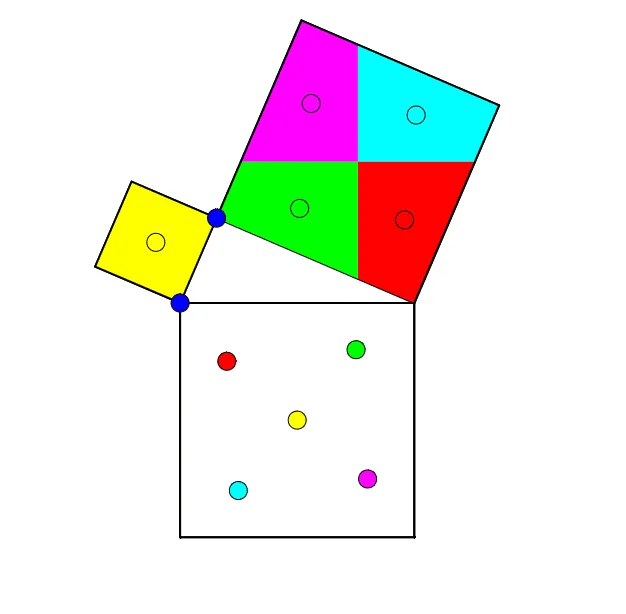
This interactive GeoGebra sketch provides a 'proof without words' for the Pythagorean theorem through a dynamic, draggable construction. By moving key points, users observe how areas or segment relationships change, leading to the visual insight that in a right triangle, the sum of the squares of the legs equals the square of the hypotenuse. Core mathematical concepts include right triangles, the Pythagorean theorem, area conservation, and geometric transformations. The construction uses GeoGebra commands such as Intersect, Point, Ray, Mirror, Semicircle, CircleArc, Segment, Polygon, Midpoint, OrthogonalLine, Vector, Centroid, and Translate to build interconnected triangles, semicircles, and auxiliary polygons. This resource is ideal for middle school and above, supporting inquiry-based learning, classroom demonstrations, or self-study to grasp the geometric essence of the Pythagorean theorem.
GeoGebra Commands & Parameters
Intersect(xAxis, yAxis) → APoint(xAxis) → BRay(A, B) → aPoint(a) → CMirror(C, A) → C'Semicircle(C, C') → cIntersect(c, yAxis) → D,CircleArc(A, D, C) → dPoint(d) → ESegment(C, E) → bSegment(E, C') → eSegment(C', C) → fPolygon(C', C, 4) → poly1, g, h, i, j, F, GPolygon(C, E, 4) → poly2, k, l, m, n, H, IPolygon(E, C', 4) → poly3, p, q, r, s, J, KMidpoint(E, J) → LOrthogonalLine(L, i) → tOrthogonalLine(L, t) → a_1Intersect(a_1, s) → MIntersect(t, r) → NIntersect(a_1, q) → OIntersect(t, e) → PPolygon(M, L, N, K) → poly4, m_1, l_1, n_1, k_1Polygon(L, N, J, O) → poly5, l_2, n_2, j_1, oPolygon(L, P, C', O) → poly6, l_3, p_1, c', o_1Polygon(P, L, M, E) → poly7, p_2, l_4, m_2, e_1Vector(L, C) → uVector(L, F) → vVector(L, C') → wVector(L, G) → u_1Centroid(poly4) → QCentroid(poly5) → RCentroid(poly6) → SCentroid(poly7) → TTranslate(T, w) → T'Translate(S, u) → S'Translate(R, v) → R'Translate(Q, u_1) → Q'Segment(Q, Q') → b_1Segment(R, R') → c_1Segment(S, S') → d_1Segment(T, T') → f_1Point(b_1) → UPoint(c_1) → VPoint(d_1) → WPoint(f_1) → ZVector(Q, U) → v_1Vector(R, V) → w_1Vector(S, W) → g_1Vector(T, Z) → h_1Translate(L, w_1) → L'Translate(N, w_1) → N'Translate(J, w_1) → J'Translate(O, w_1) → O'Polygon(L', N', J', O') → poly5', l', n', j', o'Translate(M, v_1) → M'Translate(L, v_1) → L'_1Translate(N, v_1) → N'_1Translate(K, v_1) → K'Polygon(M', L'_1, N'_1, K') → poly4', m', l'_1, n'_1, k'Translate(L, g_1) → L'_2Translate(P, g_1) → P'Translate(C', g_1) → C''Translate(O, g_1) → O'_1Polygon(L'_2, P', C'', O'_1) → poly6', l'_2, p', c'', o'_1Translate(P, h_1) → P'_1Translate(L, h_1) → L'_3Translate(M, h_1) → M'_1Translate(E, h_1) → E'Polygon(P'_1, L'_3, M'_1, E') → poly7', p'_1, l'_3, m'_1, e'Midpoint(H, C) → A_1Midpoint(C, G) → B_1Segment(A_1, B_1) → i_1Point(i_1) → C_1Vector(A_1, C_1) → q_1Translate(poly2, q_1) → poly2'