
Pythagorean Theorem Proof II (Geometric Construction & Area Relations)
Loading the math board and drawing, please wait…
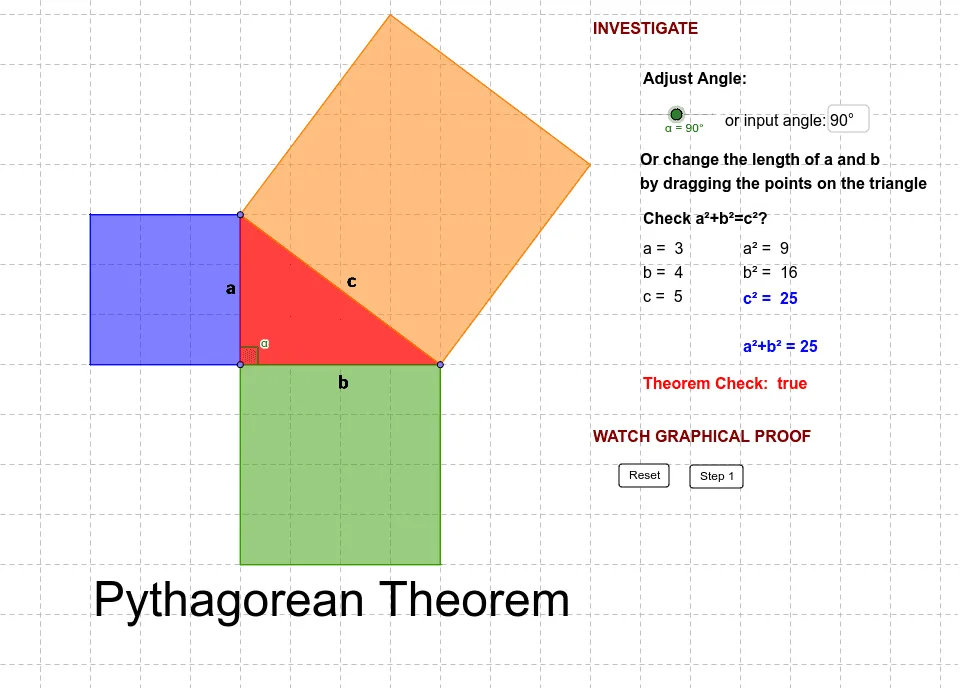
① This example dynamically demonstrates a classic proof of the Pythagorean theorem by showing the area relationship among squares built on the three sides of a right triangle. ② Core mathematical concepts include the Pythagorean theorem, right triangles, areas of squares, segment lengths, angle rotation and translation, and the area identity a² + b² = c² verified geometrically. ③ Construction highlights: Based on the construction summary, GeoGebra commands such as Line, Point, Rotate, Distance, Polygon, Segment, Angle, Midpoint, Vector, Translate, and Textfield are used. Multiple triangles (poly1–poly4), squares (aSqr, bSqr, cSqr), and auxiliary segments (a, b, c, d, e, f, g, h, i, j) are created. Rotations, translations, and midpoints are employed to partition and rearrange areas, with text fields dynamically displaying area sums. ④ Suitable for middle school to high school students learning the Pythagorean theorem and its proofs, as well as for geometry teachers seeking interactive demonstrations to explore area-based proof logic.
GeoGebra Commands & Parameters
Line(Y, Y') → a_2Point(a_2) → VPoint(a_2) → ARotate(V, α, A) → V'Line(A, V') → b_2Point(b_2) → CDistance(C, A) → aPoint(a_2) → BDistance(C, B) → cDistance(B, A) → bPolygon(A, C, 4) → poly2, c_2, d, e, f, D, ESegment(A, E) → pAngle(V, A, V') → βPolygon(C, A, B) → poly1, b_1, c_1, a_1Polygon(B, A, 4) → poly3, g, h, i, j, F, GPolygon(C, B, 4) → poly4, k, l, m, n, H, IMidpoint(a_1) → JRotate(C, -γ_1, J) → C'Rotate(A, -γ_1, J) → A'Rotate(B, -γ_1, J) → B'Polygon(C', A', B') → poly1', b', c', a'Rotate(C, -γ_2, A) → C'_1Rotate(A, -γ_2, A) → A'_1Rotate(B, -γ_2, A) → B'_1Point(p) → KVector(A, K) → uTranslate(C'_1, u) → LTranslate(A'_1, u) → MTranslate(B'_1, u) → NPolygon(L, M, N) → poly5, n_1, l_1, m_1Midpoint(m_1) → ORotate(L, -γ_3, O) → L'Rotate(M, -γ_3, O) → M'Rotate(N, -γ_3, O) → N'Polygon(L', M', N') → poly5', n', l', m'Midpoint(C, H) → PRotate(C, δ_1, P) → C'_2Rotate(A, δ_1, P) → A'_2Rotate(B, δ_1, P) → B'_2Polygon(C'_2, A'_2, B'_2) → poly1'_1, b'_2, c'_2, a'_2Rotate(C'_2, δ_2, P) → QRotate(A'_2, δ_2, P) → RRotate(B'_2, δ_2, P) → SPolygon(Q, R, S) → poly6, s, q, rRotate(Q, δ_3, P) → Q'Rotate(R, δ_3, P) → R'Rotate(S, δ_3, P) → S'Polygon(Q', R', S') → poly6', s', q', r'Textfield(α) → inputBox1Segment(A', R) → tPoint(t) → A_1Vector(A', A_1) → vTranslate(D, v) → D'Translate(A', v) → A''Translate(G, v) → G'Translate(N, v) → N'_1Polygon(D', A'', G', N'_1) → poly7', d', a'', g', n'_1Angle(A, C, B) → θAngle(A, B, C) → λ