
Pythagorean Theorem Proof by Reflection
Loading the math board and drawing, please wait…
In collections
Pythagorean Theorem
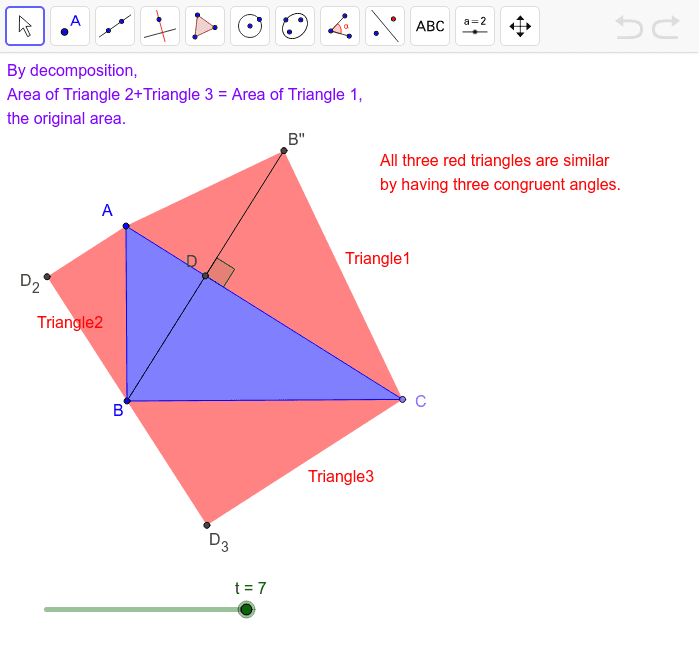
This GeoGebra example demonstrates a visual proof of the Pythagorean theorem using reflection transformations. By reflecting parts of a right triangle across its sides, the construction shows that the sum of the areas of squares on the legs equals the area of the square on the hypotenuse. Core mathematical concepts include the Pythagorean theorem, reflection symmetry, congruence, and area comparison. The construction uses GeoGebra commands such as Line, OrthogonalLine, Point, Polygon, Mirror, Segment, Intersect, and Angle, creating multiple polygons and triangles to illustrate the area relationships. Suitable for middle school or high school geometry classes, this dynamic visualization helps students grasp the geometric reasoning behind the theorem.
GeoGebra Commands & Parameters
Line(A, B) → aOrthogonalLine(B, a) → bPoint(b) → CPolygon(A, B, C) → poly1, c, a_1, b_1Mirror(B, b_1) → B'Segment(B, B') → dIntersect(b_1, d) → DMirror(D, c) → D'Mirror(D, a_1) → D'_1Polygon(D'_1, B, C) → poly2, c_1, d'_1, b_2Polygon(B, D', A) → poly3, a_2, b_3, d'Polygon(C, B', A) → poly4, a_3, c_2, b'Segment(B, B + (f(t - 1) * (B' - B))) → ePolygon(A, B'', C) → Triangle1, c_3, a_4, b''Polygon(A, B, D_2) → Triangle2, d'', a_5, b_4Polygon(B, C, D_3) → Triangle3, d'_1', b_5, c_4Angle(C, D, B'') → αAngle(C, B, A) → β
AI Drawing Prompt Reference
Draw a right triangle and reflect it across one of its legs to create a symmetric figure. Construct squares on each side of the triangle. By reflecting and rotating parts of the smaller squares, rearrange them to fill the large square on the hypotenuse, visually demonstrating that the sum of the areas of the two smaller squares equals the area of the larger square. Include multiple triangles, quadrilaterals, and angle labels to clarify the geometric proof.
The prompt above was compiled from the original drawing commands and is for reference only.