
Pythagorean Theorem Interactive Demo
Loading the math board and drawing, please wait…
In collections
Algebra 1
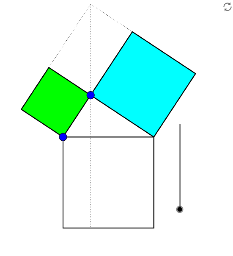
This example dynamically demonstrates the Pythagorean Theorem in right-angled triangles by dragging points and a slider. It involves core concepts like the Pythagorean Theorem, right triangles, and distance formulas. Constructed using commands such as Point, Intersect, Mirror, CircleArc, Polygon, Ray, If, Dilate, Vector, Translate, and Segment in GeoGebra. Ideal for middle school and above to understand proof and application, enhancing spatial reasoning.
GeoGebra Commands & Parameters
Point(xAxis) → AIntersect(xAxis, yAxis) → BMirror(A, B) → A'CircleArc(B, C, A) → cPoint(c) → DPolygon(A, D, 4) → poly1, a, b, d, e, E, FPolygon(D, A', 4) → poly2, f, g, h, i, G, HPolygon(A', A, 4) → poly3, j, k, l, m, I, JRay(F, E) → nRay(G, H) → pIntersect(n, p) → KRay(K, D) → qIf(0 ≤ o < 1, 1 - o, 0) → scale1Dilate(E, scale1, K) → E'Dilate(H, scale1, K) → H'Vector(E, F) → uVector(H, G) → vTranslate(E', u) → E''Translate(H', v) → H''Polygon(E', D, A, E'') → poly4, e', d_1, a_1, e''Polygon(A', H'', H', D) → poly5, a', h'', h', d_2If(1 ≤ o < 2, 2 - o, 1) → scale2Dilate(K, scale2, D) → K'Vector(K, K') → wTranslate(E', w) → E''_1Translate(D, w) → D'Translate(A, w) → A'_1Translate(E'', w) → E'''Polygon(E''_1, D', A'_1, E''') → poly4', e''_1, d', a'_1, e'''Translate(A', w) → A''Translate(H'', w) → H'''Translate(H', w) → H''_1Translate(D, w) → D'_1Polygon(A'', H''', H''_1, D'_1) → poly5', a'', h''', h''_1, d'_1Intersect(j, q) → LIf(2 ≤ o ≤ 3, 3 - o, 1) → scale3Dilate(D, scale3, L) → D'_2Vector(A, I) → rTranslate(D'_2, r) → MPolygon(I, A, D'_2, M) → poly6, i_1, a_2, d'_2, m_1Polygon(D'_2, A', J, M) → poly7, d'_3, a'_2, j_1, m_2Segment(E, K) → sSegment(K, H) → tRay(K, L) → b_1Intersect(l, b_1) → NSegment(K, N) → c_1
AI Drawing Prompt Reference
Draw a right triangle ABC with A on the x-axis, B at the origin, and C on the y-axis. Dynamically demonstrate the Pythagorean Theorem by dragging points and using a slider. Construct a circular arc with B as the center and BC as the radius, and connect A and D to form a polygon. Then construct another circular arc with A' as the center and A'D as the radius, and connect D and A' to form another polygon. Finally, use scaling and translation to construct multiple polygons and segments, illustrating the proof of the Pythagorean Theorem.
The prompt above was compiled from the original drawing commands and is for reference only.