
Pythagorean Theorem Generalization to All Polygons
Loading the math board and drawing, please wait…
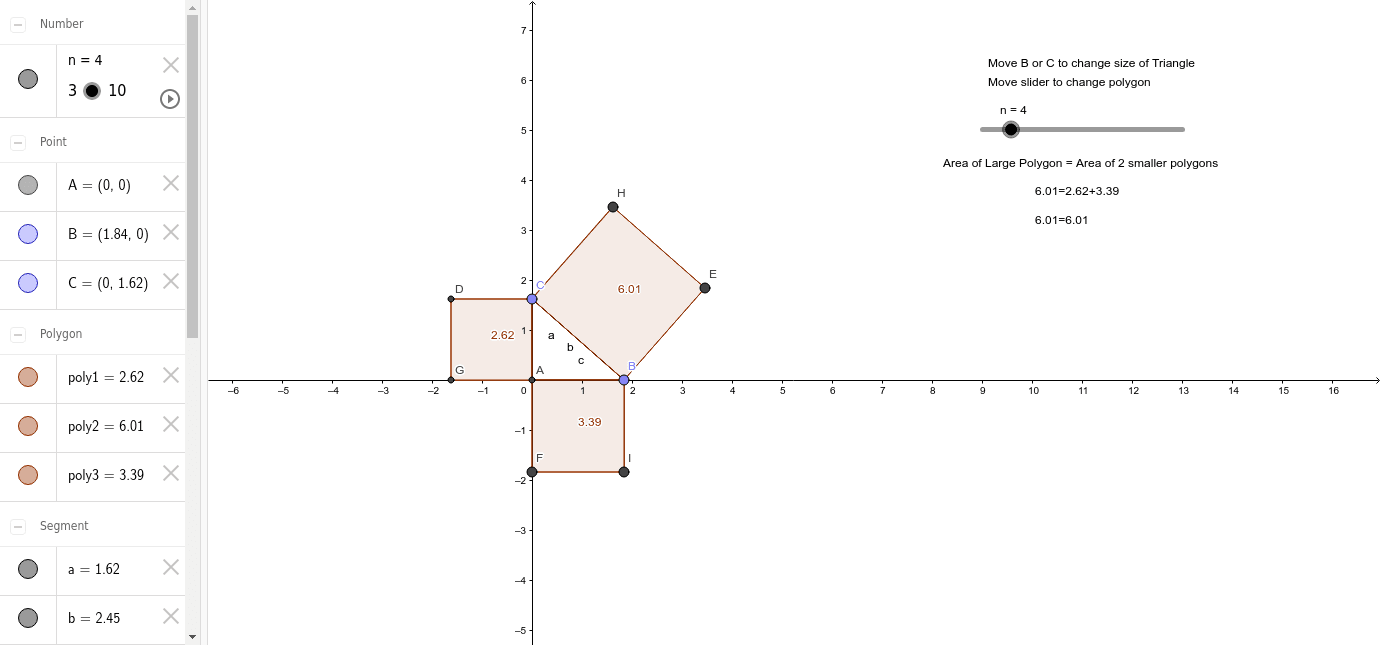
This GeoGebra example demonstrates the generalization of the Pythagorean theorem from right triangles to arbitrary polygons, illustrating the area relationship when polygons with the same number of sides are constructed on the three sides of a right triangle. Core mathematical concepts include the Pythagorean theorem, polygon area, regular polygon construction, similarity transformations, and parametric variation driven by the slider n. The construction uses GeoGebra commands Intersect, Point, Segment, and Polygon, with objects A, B, C defining the right triangle and poly1, poly2 together with parameters a, b, c, n and derived points D, E, F, G, H, J, K, M, P, S, V to generate the associated polygons dynamically. It is suitable for secondary school geometry instruction, theorem exploration, and interactive classroom demonstrations of polygon area relationships.
GeoGebra Commands & Parameters
Intersect(xAxis, yAxis) → APoint(xAxis) → BPoint(yAxis) → CSegment(A, C) → aSegment(C, B) → bSegment(B, A) → cPolygon(A, C, n) → poly1, d, m_1, D, G, J, M, P, S, V, A_1, e, f, m, r, a_1, d_1, g_1, j_1Polygon(C, B, n) → poly2, g, n_1, E, H, K, N, Q, T, W, B_1, h, i, p, s, b_1, e_1, h_1, k_1Polygon(B, A, n) → poly3, j, p_1, F, I, L, O, R, U, Z, C_1, k, l, q, t, c_1, f_1, i_1, l_1