
Pythagorean Theorem: Dynamic Geometric Demonstration with Polygon Areas
Loading the math board and drawing, please wait…
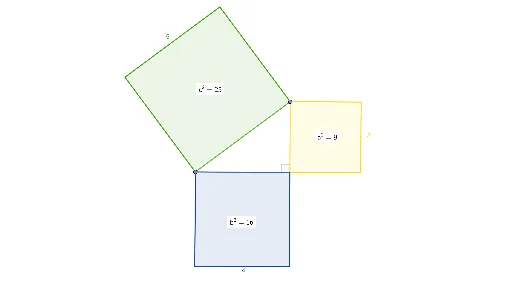
This GeoGebra example provides an interactive geometric demonstration of the Pythagorean theorem, showing that in a right triangle, the sum of the areas of the squares on the two legs equals the area of the square on the hypotenuse. The core mathematical concepts involved are right triangles, the Pythagorean theorem, polygon area calculation, rotation, and angle measurement. The construction uses GeoGebra commands such as Line, Rotate, Angle, Point, Polygon, PointIn, and Distance to build the right triangle ABC and the three squares (poly1, poly2, poly3) on its sides, then verifies the area relationship through rotation and distance measurements. This resource is suitable for middle school and above students learning the Pythagorean theorem, and is also valuable for teachers demonstrating the theorem in class or for students exploring geometric proofs and area-based verification independently.
GeoGebra Commands & Parameters
Line(A, B) → fRotate(A, (-(90°)), B) → A'Angle(A', B, A) → αLine(B, A') → gPoint(f) → CPoint(g) → DPolygon(C, B, D) → t1, d, c, bPolygon(C, D, 4) → poly1, h, i, j, k, E, FPolygon(D, B, 4) → poly2, l, m, n, p, G, HPolygon(B, C, 4) → poly3, q, r, s, t, I, JPointIn(poly1) → Pointpoly1_1PointIn(poly2) → Pointpoly2_1PointIn(poly3) → Pointpoly3_1PointIn(poly1) → Pointpoly1_2PointIn(poly3) → Pointpoly3_2PointIn(poly2) → Pointpoly2_2Distance(n, s) → aPointIn(poly1) → Pointpoly1PointIn(poly2) → Pointpoly2PointIn(poly3) → Pointpoly3
AI Drawing Prompt Reference
Draw a right triangle with one leg horizontal and the other leg slanted upward from the endpoint of the horizontal leg. Construct squares outward on each of the three sides, with each square sharing one side with the triangle. Place a point inside each square, and measure the distance between a side of the hypotenuse square and a side of another square to visually show that the sum of the areas of the two leg squares equals the area of the hypotenuse square. The figure should include triangle vertices, square vertices, and interior points, with a clear layout for observing the area relationship.
The prompt above was compiled from the original drawing commands and is for reference only.