
Pythagorean Theorem Demonstration with Cone Construction
Loading the math board and drawing, please wait…
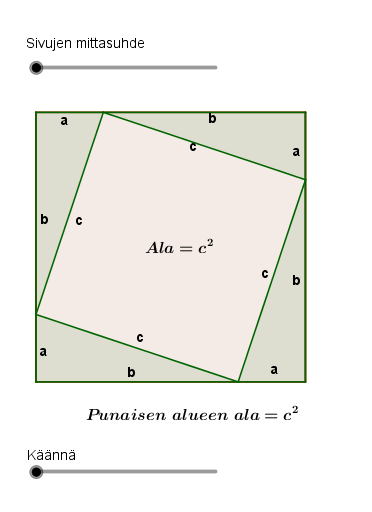
① This example dynamically demonstrates the Pythagorean theorem in a right triangle, using cone-related constructions and polygon areas to illustrate the sum of squares of the legs equals the square of the hypotenuse. ② Core mathematical concepts include right triangles, the Pythagorean theorem, area conservation, geometric transformations (rotation), and properties of cones and their cross-sections. ③ Construction highlights: Using GeoGebra commands such as Polygon, Ray, Rotate, If, Angle, Intersect, OrthogonalLine, and Midpoint, the construction builds multiple polygons (poly1, poly2, poly3), auxiliary lines (f, g, h, i), rotated objects (K', D'_1), and cone-related elements (o, r, t). Sliders or angle parameters (α, β, γ) allow dynamic adjustment to explore area relationships. ④ Suitable for middle and high school mathematics, this interactive tool helps verify the theorem visually, supports area-based proofs, and serves as a dynamic teaching resource for geometry lessons.
GeoGebra Commands & Parameters
Polygon(A, B, 4) → poly1, f, g, h, i, C, DRay(A, B) → eRotate(B + ((b_1 * abs(x(A) - x(B))), 0), If[a < π / 2, (-a), ((-π)) / 2], F) → ERotate(F + (0, abs(y(F) - y(B))), If[a < π / 2, (-a), ((-π)) / 2], F) → IIf(a < π / 2, ((-π)) / 2, asin((y(K) - y(A)) / o)) → rRotate(K, r°, A) → K'Rotate(D, (-(π / 2 - r)), K) → D'_1Angle(D'_1, K, D) → βRay(K, D'_1) → nIntersect(n, e) → LOrthogonalLine(L, n) → sAngle(C, F, G) → αRotate(L, α, K) → L'Angle(L, K, L') → γRay(K, L') → tIntersect(s, t) → OPolygon(F, I, E) → poly2, e_1, f_1, i_1Polygon(F, C, G) → poly3, g_1, f_2, cPolygon(K, M, N) → poly4, n_1, k, mPolygon(L, O, K) → poly5, k_1, l, o_1Midpoint(F, E) → QMidpoint(G, F) → TMidpoint(C, F) → VMidpoint(C, G) → WMidpoint(I, F) → UMidpoint(E, I) → D_1Midpoint(O, L) → bMidpoint(M, K) → RMidpoint(K, O) → SMidpoint(K, L) → B_1Midpoint(B, D) → PMidpoint(M, N) → ZMidpoint(N, K) → A_1
AI Drawing Prompt Reference
Draw a right triangle to dynamically demonstrate the Pythagorean theorem, illustrating the sum of squares of the legs equals the square of the hypotenuse through cone-related constructions and polygon area relationships. Include multiple rotated polygons, auxiliary lines, rotated objects, and cone elements, with sliders or angle parameters for dynamic adjustment to explore area relationships.
The prompt above was compiled from the original drawing commands and is for reference only.