
Pythagorean Theorem Demo
Loading the math board and drawing, please wait…
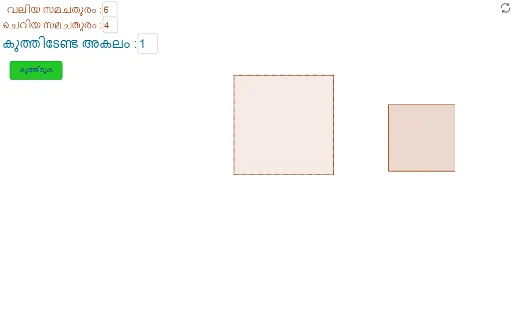
This example demonstrates the Pythagorean theorem in right triangles, showing the relationship between the lengths of the sides. Key math concepts include the Pythagorean theorem, right triangles, and side length calculations. It is constructed using commands like Polygon, Segment, Intersect, Mirror, Point, Textfield, Vector, Translate, and Dilate. Suitable for middle school students and above to learn and understand the theorem.
GeoGebra Commands & Parameters
Polygon(B, A, 4) → poly1, c, d, e, f, C, DSegment(E, F) → hSegment(G, H) → iIntersect(h, i) → IPolygon(C, E, I, H) → poly2, c_1, e_1, i_1, h_1Polygon(H, I, F, A) → poly3, h_2, i_2, f_1, a_1Polygon(I, G, B, F) → poly4, i_3, g_1, b_1, f_2Polygon(E, D, G, I) → poly5, e_2, d_1, g_2, i_4Mirror(C, l) → C'Mirror(E, l) → E'Mirror(I, l) → I'Mirror(H, l) → H'Polygon(C', E', I', H') → poly2', c', e', i', h'Mirror(H, j) → H'_1Mirror(I, j) → I'_1Mirror(F, j) → F'Mirror(A, j) → A'Polygon(H'_1, I'_1, F', A') → poly3', h'_1, i'_1, f', a'Mirror(I, m) → I'_2Mirror(G, m) → G'Mirror(B, m) → B'Mirror(F, m) → F'_1Polygon(I'_2, G', B', F'_1) → poly4', i'_2, g', b', f'_1Mirror(E, k) → E'_1Mirror(D, k) → D'Mirror(G, k) → G'_1Mirror(I, k) → I'_3Polygon(E'_1, D', G'_1, I'_3) → poly5', e'_1, d', g'_1, i'_3Point(Circle[O, r]) → PSegment(O, P) → sPolygon(O, P, 4) → poly6, t, j_1, p_1, q_1, Q, RTextfield(a) → inputBox1Textfield(r) → inputBox2Textfield(b) → inputBox3Intersect(f, d') → UIntersect(f, d') → VVector(E', E'_1) → uTranslate(C', u) → C''Translate(E', u) → E''Translate(I', u) → I''Translate(H', u) → H''Polygon(C'', E'', I'', H'') → poly2'', c'', e'', i'', h''Vector(H'_1, H'') → vTranslate(H'_1, v) → JTranslate(I'_1, v) → KTranslate(F', v) → F''Translate(A', v) → A''Polygon(J, K, F'', A'') → poly3'', j_2, k_1, f'', a''Vector(G', G'_1) → wTranslate(I'_2, w) → LTranslate(G', w) → G''Translate(B', w) → B''Translate(F'_1, w) → MDilate(E'_1, n, E') → NVector(E', N) → pTranslate(C', p) → C''_1Translate(E', p) → E''_1Translate(I', p) → I''_1Translate(H', p) → H''_1Polygon(C''_1, E''_1, I''_1, H''_1) → poly2''_1, c''_1, e''_1, i''_1, h''_1Dilate(H'', n - 1, H'_1) → H'''Vector(H'_1, H''') → u_1Translate(H'_1, u_1) → WTranslate(I'_1, u_1) → ZTranslate(F', u_1) → F''_1Translate(A', u_1) → A''_1Polygon(W, Z, F''_1, A''_1) → poly3''_1, w_1, z_1, f''_1, a''_1Dilate(G'_1, n - 2, G') → C_1Vector(G', C_1) → v_1Translate(I'_2, v_1) → D_1Translate(G', v_1) → G''_1Translate(B', v_1) → B''_1Translate(F'_1, v_1) → E_1Polygon(D_1, G''_1, B''_1, E_1) → poly4''_1, d_2, g''_1, b''_1, e_3Dilate(B'', t_1, O) → B'''Vector(O, B''') → n_1Translate(poly6, n_1) → poly6'Segment(B', G') → l_1Segment(E''_1, C''_1) → m_1Segment(C''_1, H''_1) → a_2Segment(E'', C'') → b_2Segment(H'', C'') → c_2
AI Drawing Prompt Reference
Draw a right triangle with labeled side lengths, fill the areas of the squares on the two legs and the hypotenuse to demonstrate the Pythagorean theorem. Include a slider to adjust the triangle's size, and use reflection and vector tools to create auxiliary shapes for verification.
The prompt above was compiled from the original drawing commands and is for reference only.