
Comparing Fractions by Merton Dsilva
Loading the math board and drawing, please wait…
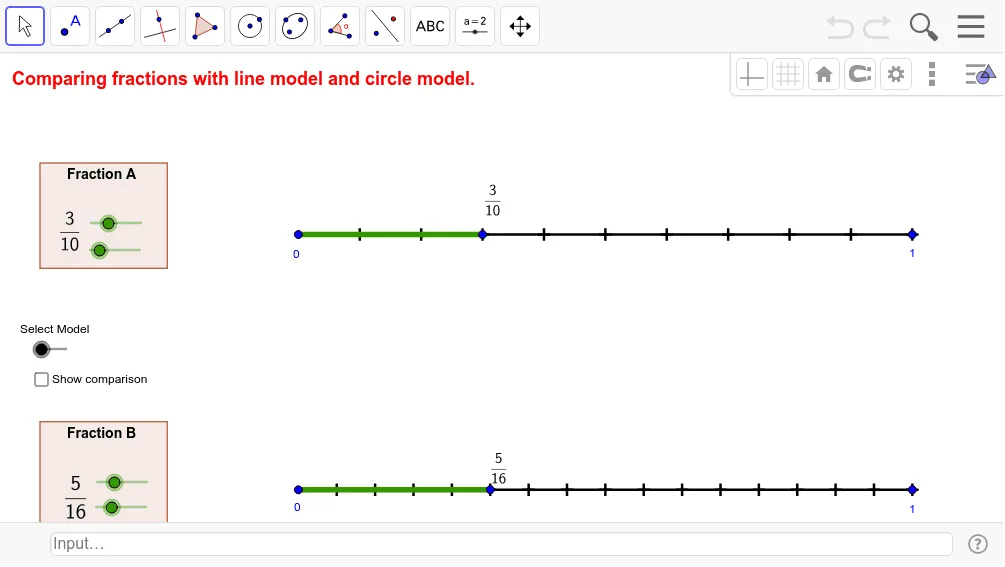
This example demonstrates how to visually compare the sizes of two fractions. It involves core mathematical concepts such as fractions, denominators, numerators, geometric representation, and geometric construction. The construction uses commands like Segment, Sequence, Circle, Point, Rotate, CircleSector, Polygon in GeoGebra. Suitable for middle school students and above to learn and understand the intuitive method of comparing fractions, or for mathematical teaching demonstrations.
GeoGebra Commands & Parameters
Segment(A, A + (unitsize1, 0)) → line1Segment(B, B + (unitsize2, 0)) → line2Sequence((x(A) + i * unitsize1 / denominator1, y(A)), i, 1, denominator1) → numdots1Sequence((x(B) + i * unitsize2 / denominator2, y(B)), i, 1, denominator2) → numdots2Segment(E, (x(E), y(E) - (y(A) - y(B)))) → showcomparison_1Segment(A, E) → showfrac1_1Segment(B, F) → showfrac2_1Circle(G, unitradius) → cPoint(c) → HSegment(G, H) → aRotate(G, 360 * ° / denominator1, G) → G'Sequence(Segment[Rotate[G, i * 360 * ° / denominator1, G], Rotate[H, i * 360 * ° / denominator1, G]], i, 1, denominator1) → denominatorwedges1Circle(I, unitradius) → dPoint(d) → JSegment(I, J) → bSequence(Segment[Rotate[I, i * 360 * ° / denominator2, I], Rotate[J, i * 360 * ° / denominator2, I]], i, 1, denominator2) → denominatorwedges2Rotate(H, numerator1 * 360 * ° / denominator1, G) → H'Rotate(J, numerator2 * 360 * ° / denominator2, I) → J'CircleSector(G, H, H') → numeratorwedge1CircleSector(I, J, J') → numeratorwedge2Polygon(K, (x(K), y(K) - boxheight), (x(K) + boxwidth, y(K) - boxheight), (x(K) + boxwidth, y(K))) → poly1, e, f, g, hPolygon(L, (x(L), y(L) - boxheight), (x(L) + boxwidth, y(L) - boxheight), (x(L) + boxwidth, y(L))) → poly2, l, i, j, k
AI Drawing Prompt Reference
Draw two horizontal line segments, divide the first one into equal parts according to the first denominator and mark points, do the same for the second line segment with the second denominator. Connect corresponding points with vertical segments to show the geometric representation of two fractions. Compare the sizes of the numerators by rotating circular sectors, and enclose the comparison result in rectangles.
The prompt above was compiled from the original drawing commands and is for reference only.