
Pythagorean Theorem by Tessellation
Loading the math board and drawing, please wait…
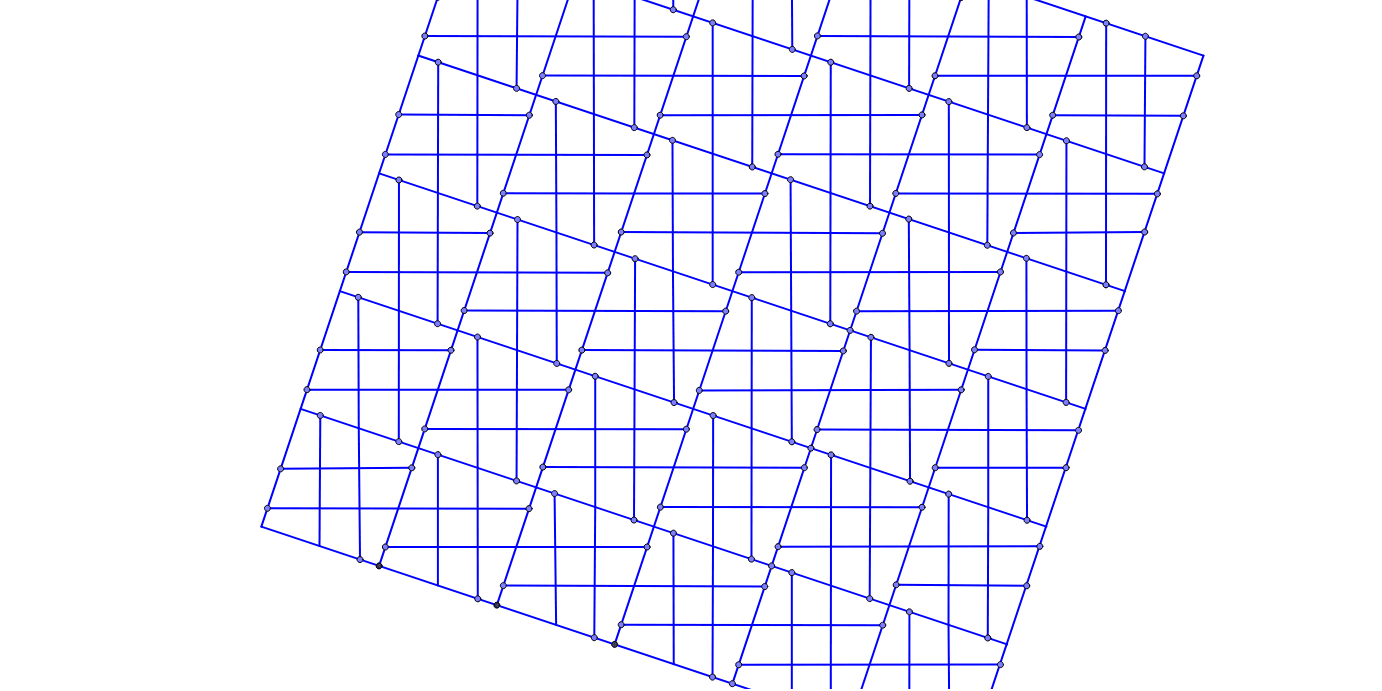
This example visually demonstrates the Pythagorean Theorem through tessellations, illustrating that the sum of the squares of the two legs of a right triangle equals the square of the hypotenuse. Core mathematical concepts include the Pythagorean Theorem, squares, and area calculations. It is constructed using GeoGebra commands/objects like Line, OrthogonalLine, Point, Segment, and Intersect. Suitable for middle school students and above to learn and understand the geometric meaning of the Pythagorean Theorem, as well as for mathematical teaching demonstrations.
GeoGebra Commands & Parameters
Line(A, B) → aOrthogonalLine(B, a) → bOrthogonalLine(A, a) → cPoint(b) → COrthogonalLine(C, b) → dPoint(b) → DOrthogonalLine(D, b) → ePoint(b) → EOrthogonalLine(E, b) → fPoint(b) → FOrthogonalLine(F, b) → gPoint(b) → GOrthogonalLine(G, b) → hPoint(b) → HOrthogonalLine(H, b) → iPoint(i) → IOrthogonalLine(I, i) → jPoint(g) → JOrthogonalLine(J, g) → kPoint(g) → KOrthogonalLine(K, g) → lPoint(g) → LOrthogonalLine(L, g) → mPoint(g) → MOrthogonalLine(M, g) → nPoint(c) → NPoint(b) → OSegment(N, O) → pPoint(j) → PSegment(P, N) → qPoint(a) → QPoint(d) → RSegment(Q, R) → rPoint(b) → SPoint(c) → TSegment(S, T) → sPoint(c) → UPoint(k) → VSegment(U, V) → tPoint(a) → WPoint(e) → ZSegment(W, Z) → a_1Point(a) → A_1Point(d) → B_1Segment(A_1, B_1) → b_1Point(a) → C_1Point(e) → D_1Segment(C_1, D_1) → c_1Point(d) → E_1Point(f) → F_1Segment(E_1, F_1) → d_1Point(j) → G_1Point(b) → H_1Segment(G_1, H_1) → e_1Point(b) → I_1Point(c) → J_1Segment(I_1, J_1) → f_1Point(c) → K_1Point(k) → L_1Segment(K_1, L_1) → g_1Point(j) → M_1Point(k) → N_1Segment(M_1, N_1) → h_1Point(d) → O_1Point(f) → P_1Segment(O_1, P_1) → i_1Point(e) → Q_1Point(g) → R_1Segment(Q_1, R_1) → j_1Point(f) → S_1Point(h) → T_1Segment(S_1, T_1) → k_1Point(g) → U_1Point(i) → V_1Segment(U_1, V_1) → l_1Point(h) → W_1Point(i) → Z_1Segment(W_1, Z_1) → m_1Point(b) → A_2Point(j) → B_2Segment(A_2, B_2) → n_1Point(c) → C_2Point(b) → D_2Segment(C_2, D_2) → p_1Point(b) → E_2Point(j) → F_2Segment(E_2, F_2) → q_1Point(c) → G_2Point(b) → H_2Segment(G_2, H_2) → r_1Point(b) → I_2Point(j) → J_2Segment(I_2, J_2) → s_1Point(c) → K_2Point(b) → L_2Segment(K_2, L_2) → t_1Point(b) → M_2Point(j) → N_2Segment(M_2, N_2) → a_2Point(c) → O_2Point(b) → P_2Segment(O_2, P_2) → b_2Point(k) → Q_2Point(c) → R_2Segment(Q_2, R_2) → c_2Point(e) → S_2Point(g) → T_2Segment(S_2, T_2) → d_2Point(f) → U_2Point(h) → V_2Segment(U_2, V_2) → e_2Point(g) → W_2Point(i) → Z_2Segment(W_2, Z_2) → f_2Point(c) → A_3Point(k) → B_3Segment(A_3, B_3) → g_2Point(h) → C_3Point(i) → D_3Segment(C_3, D_3) → h_2Point(k) → E_3Point(c) → F_3Segment(E_3, F_3) → i_2Point(g) → G_3Point(i) → H_3Segment(G_3, H_3) → j_2Point(h) → I_3Point(i) → J_3Segment(I_3, J_3) → k_2Point(k) → K_3Point(j) → L_3Segment(K_3, L_3) → l_2Point(k) → M_3Point(j) → N_3Segment(M_3, N_3) → m_2Point(f) → O_3Point(h) → P_3Segment(O_3, P_3) → n_2Point(k) → Q_3Point(c) → R_3Segment(Q_3, R_3) → p_2Point(e) → S_3Point(g) → T_3Segment(S_3, T_3) → q_2Point(j) → U_3Point(k) → V_3Segment(U_3, V_3) → r_2Point(f) → W_3Point(e) → Z_3Segment(W_3, Z_3) → s_2Point(d) → A_4Segment(A_4, Z_3) → t_2Point(a) → B_4Point(d) → C_4Segment(B_4, C_4) → a_3Point(a) → D_4Point(e) → E_4Segment(D_4, E_4) → b_3Point(l) → F_4Point(j) → G_4Segment(F_4, G_4) → c_3Point(a) → H_4Point(d) → I_4Segment(H_4, I_4) → d_3Point(a) → J_4Point(e) → K_4Segment(J_4, K_4) → e_3Point(k) → L_4Point(m) → M_4Segment(L_4, M_4) → f_3Point(d) → N_4Point(f) → O_4Segment(N_4, O_4) → g_3Point(l) → P_4Segment(P_4, N_1) → h_3Point(m) → Q_4Point(k) → R_4Segment(Q_4, R_4) → i_3Point(m) → S_4Point(k) → T_4Segment(S_4, T_4) → j_3Point(l) → U_4Segment(U_4, V_3) → k_3Point(m) → V_4Point(l) → W_4Segment(V_4, W_4) → l_3Point(e) → Z_4Point(g) → A_5Segment(Z_4, A_5) → m_3Point(k) → B_5Point(m) → C_5Segment(B_5, C_5) → n_3Point(f) → D_5Point(h) → E_5Segment(D_5, E_5) → p_3Point(l) → F_5Point(k) → G_5Segment(F_5, G_5) → q_3Point(g) → H_5Point(i) → I_5Segment(H_5, I_5) → r_3Point(l) → J_5Segment(J_5, K_3) → s_3Point(l) → K_5Point(k) → L_5Segment(K_5, L_5) → t_3Point(d_1) → M_5Point(d_1) → N_5Point(d_1) → O_5Point(k) → P_5Point(m) → Q_5Segment(P_5, Q_5) → a_4Point(f) → R_5Point(h) → S_5Segment(R_5, S_5) → b_4Point(g) → T_5Point(i) → U_5Segment(T_5, U_5) → c_4Point(m) → V_5Point(l) → W_5Segment(V_5, W_5) → d_4Point(l) → Z_5Segment(M_3, Z_5) → e_4Point(m) → A_6Segment(A_6, K_5) → f_4Point(h) → B_6Point(i) → C_6Segment(B_6, C_6) → g_4Point(h) → D_6Point(i) → E_6Segment(D_6, E_6) → h_4Point(m) → F_6Point(l) → G_6Segment(F_6, G_6) → i_4Point(m) → H_6Point(l) → I_6Segment(H_6, I_6) → j_4Point(e) → J_6Point(g) → K_6Segment(J_6, K_6) → k_4Point(d) → L_6Point(f) → M_6Segment(L_6, M_6) → l_4Point(a) → N_6Point(d) → O_6Segment(N_6, O_6) → m_4Point(a) → P_6Point(e) → Q_6Segment(P_6, Q_6) → n_4Point(d) → R_6Point(f) → S_6Segment(R_6, S_6) → p_4Point(l) → T_6Point(n) → U_6Segment(T_6, U_6) → q_4Point(n) → V_6Point(m) → W_6Segment(V_6, W_6) → r_4Point(n) → Z_6Point(m) → A_7Segment(Z_6, A_7) → s_4Point(m) → B_7Point(n) → C_7Segment(B_7, C_7) → t_4Point(l) → D_7Segment(D_7, A_7) → a_5Point(a) → E_7Point(d) → F_7Segment(E_7, F_7) → b_5Point(a) → G_7Point(e) → H_7Segment(G_7, H_7) → c_5Point(e) → I_7Point(g) → J_7Segment(I_7, J_7) → d_5Point(f) → K_7Point(h) → L_7Segment(K_7, L_7) → e_5Point(g) → M_7Point(i) → N_7Segment(M_7, N_7) → f_5Point(h) → O_7Point(i) → P_7Segment(O_7, P_7) → g_5Point(n) → Q_7Segment(Q_7, V_5) → h_5Point(n) → R_7Segment(R_7, F_6) → i_5Point(n) → S_7Segment(S_7, H_6) → j_5Point(n) → T_7Segment(T_7, V_4) → k_5Point(m) → U_7Point(n) → V_7Segment(U_7, V_7) → l_5Point(m) → W_7Point(n) → Z_7Segment(W_7, Z_7) → m_5Point(m) → A_8Point(n) → B_8Segment(A_8, B_8) → n_5Point(m) → C_8Point(n) → D_8Segment(C_8, D_8) → p_5Point(j) → E_8Segment(E_8, G_5) → q_5Segment(G_7, F_8) → r_5Segment(G_7, B) → s_5Segment(B, H) → t_5Point(n) → G_8Segment(H, G_8) → a_6Segment(F_8, G_8) → b_6Segment(R_6, C) → c_6Segment(J_6, D) → d_6Segment(S_6, E) → e_6Segment(K_6, F) → f_6Segment(D_6, G) → g_6Point(c) → H_8Segment(H_8, A) → h_6Point(j) → I_8Segment(I_8, I) → i_6Intersect(i, k) → J_8Intersect(a, k) → K_8Segment(J_8, K_8) → j_6Intersect(a, l) → L_8Intersect(i, l) → M_8Segment(L_8, M_8) → k_6Intersect(h, n) → N_8Segment(N_8, D_6) → l_6Segment(M, K_6) → m_6Intersect(f, n) → O_8Segment(O_8, S_6) → n_6Intersect(i, m) → P_8Intersect(a, m) → Q_8Segment(P_8, Q_8) → p_6Intersect(d, n) → R_8Segment(R_8, R_6) → q_6Intersect(e, n) → S_8Segment(S_8, J_6) → r_6
AI Drawing Prompt Reference
Draw a right triangle and tessellate it infinitely by drawing orthogonal lines around its hypotenuse, forming a geometric pattern. Start by drawing the two legs of the right triangle, then draw orthogonal lines from each vertex, and continue to draw new points and lines on these orthogonal lines to form a grid-like pattern.
The prompt above was compiled from the original drawing commands and is for reference only.