
Pythagorean Theorem and Pythagorean Inequalities
Loading the math board and drawing, please wait…
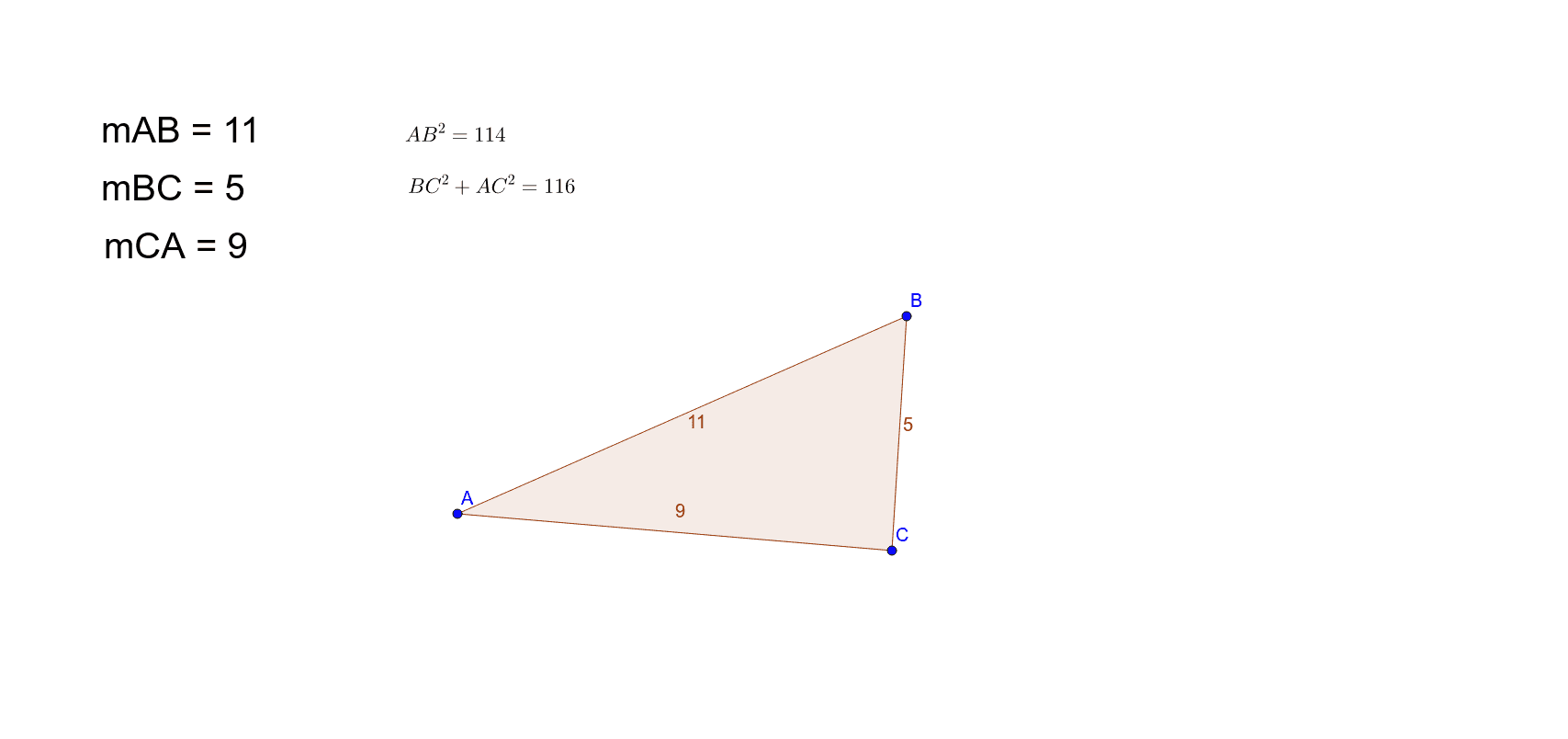
① This interactive GeoGebra example demonstrates the Pythagorean theorem and its inequalities, showing how the sum of squares of two sides compares to the square of the third side in acute, right, and obtuse triangles. ② Core mathematical concepts include the Pythagorean theorem, triangle classification, inequalities, and two-dimensional vectors. ③ Construction details: using the Polygon command to create triangle ABC, with sides a, b, c and text objects text1-text5 displaying computed values; vectors and multiplication are involved to illustrate squared lengths. ④ Suitable for middle and high school students, ideal for exploring the theorem dynamically in geometry lessons or for teacher-created interactive materials.
GeoGebra Commands & Parameters
Polygon(A, B, C) → poly1, c, a, b
AI Drawing Prompt Reference
Draw a triangle with vertices labeled A, B, and C, showing all three sides. Display the squared lengths of each side, and compare the sum of squares of two sides with the square of the third side. As the triangle is dynamically adjusted, visually demonstrate how the relationship changes for acute, right, and obtuse triangles. Include clear side labels and numerical text to illustrate the Pythagorean theorem and its inequalities.
The prompt above was compiled from the original drawing commands and is for reference only.