
Pythagorean Circle Definition
Loading the math board and drawing, please wait…
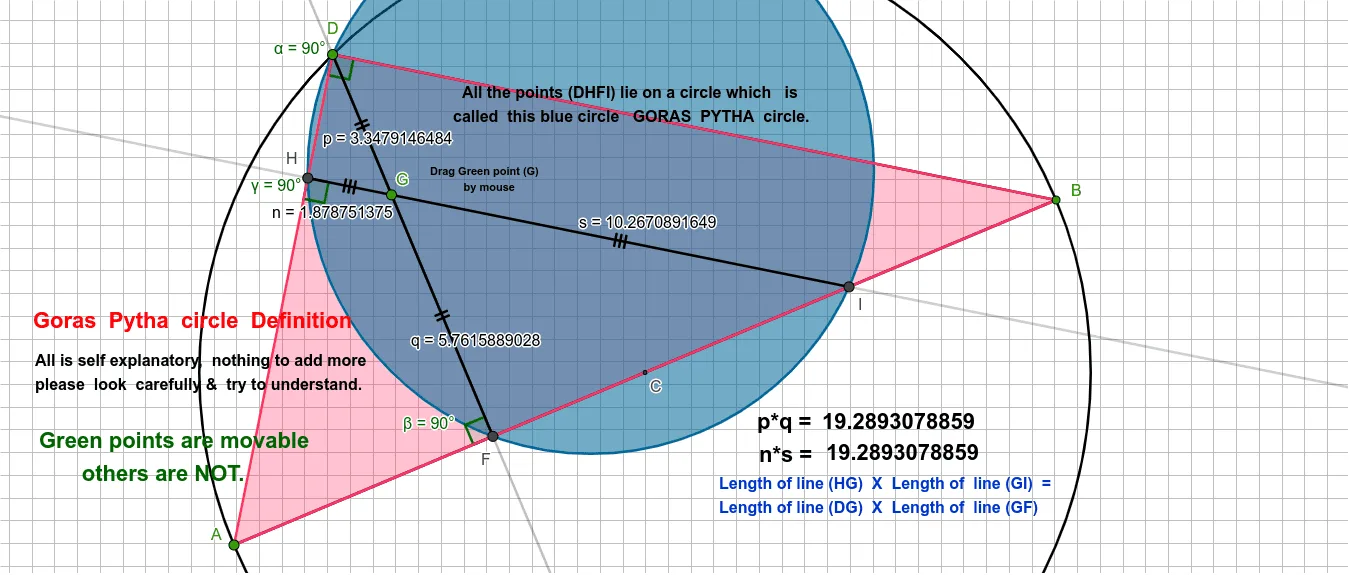
This example illustrates the definition of the Pythagorean circle. Key mathematical concepts include the Pythagorean theorem and properties of circles. Construction highlights include the use of segment, midpoint, circle, angle bisector, and other GeoGebra commands. Suitable for middle school and above students to learn about geometric transformations and circle properties.
GeoGebra Commands & Parameters
Segment(A, B) → fMidpoint(A, B) → CCircle(C, B) → cLineBisector(f) → gPoint(c) → DSegment(D, A) → hSegment(D, B) → iAngle(A, D, B) → αPolygon(A, D, B) → t1, b, a, dOrthogonalLine(D, f) → jIntersect(f, d) → EIntersect(j, f) → FSegment(D, F) → kAngle(D, F, A) → βPoint(k) → GLine(G, i) → lIntersect(l, h) → HSegment(H, G) → nSegment(D, G) → pSegment(G, F) → qAngle(h, n) → γIntersect(l, f) → ISegment(G, I) → sCircle(D, H, I) → e
AI Drawing Prompt Reference
Draw a right triangle, mark the midpoint of the hypotenuse and the legs, and draw a circle centered at the midpoint of the hypotenuse with the hypotenuse as the radius. Bisect the angle of the right triangle and find the intersection point of the bisector with the circle. Connect this point to the vertices of the triangle to form two smaller triangles. Then, draw a perpendicular line to the angle bisector, find its intersection with the hypotenuse, and connect these points to create new geometric shapes. Finally, draw a circle with specific points as the center to illustrate geometric properties.
The prompt above was compiled from the original drawing commands and is for reference only.