
Pythagoras' Theorem Practice
Loading the math board and drawing, please wait…
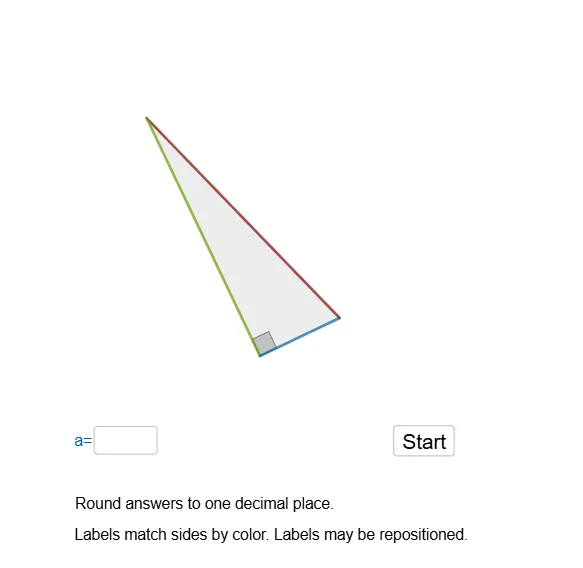
This example demonstrates the Pythagorean theorem, which states that in a right-angled triangle, the square of the length of the hypotenuse (the side opposite the right angle) is equal to the sum of the squares of the lengths of the other two sides. Key mathematical concepts include right-angled triangles, the Pythagorean theorem, and geometric construction. It uses commands like Polygon, Angle, Midpoint, Circle, and Textfield in GeoGebra.
GeoGebra Commands & Parameters
Random(1, 10) → pPolygon(B, A, C) → t1, c_1, b, a_1Angle(B, C, A) → βMidpoint(B, C) → DMidpoint(C, A) → EMidpoint(A, B) → FAngle(C, A, B) → γAngle(A, B, C) → δShuffle(list1) → list2, {0, 0, 1}Circle((0, 0), d) → cTextfield(empty1) → InputBox1Textfield(empty2) → InputBox2Textfield(empty3) → InputBox3UnitOrthogonalVector((E, C)) → i
AI Drawing Prompt Reference
Draw a right triangle ABC with angle B as the right angle. Mark the midpoints D, E, and F of the hypotenuse AC, and the legs BC and AB, respectively. Measure the angles CAB, ABC, and BCA. Draw a circle centered at the origin with radius equal to the length of DE.
The prompt above was compiled from the original drawing commands and is for reference only.