
Pythagoras' Theorem Part 4
Loading the math board and drawing, please wait…
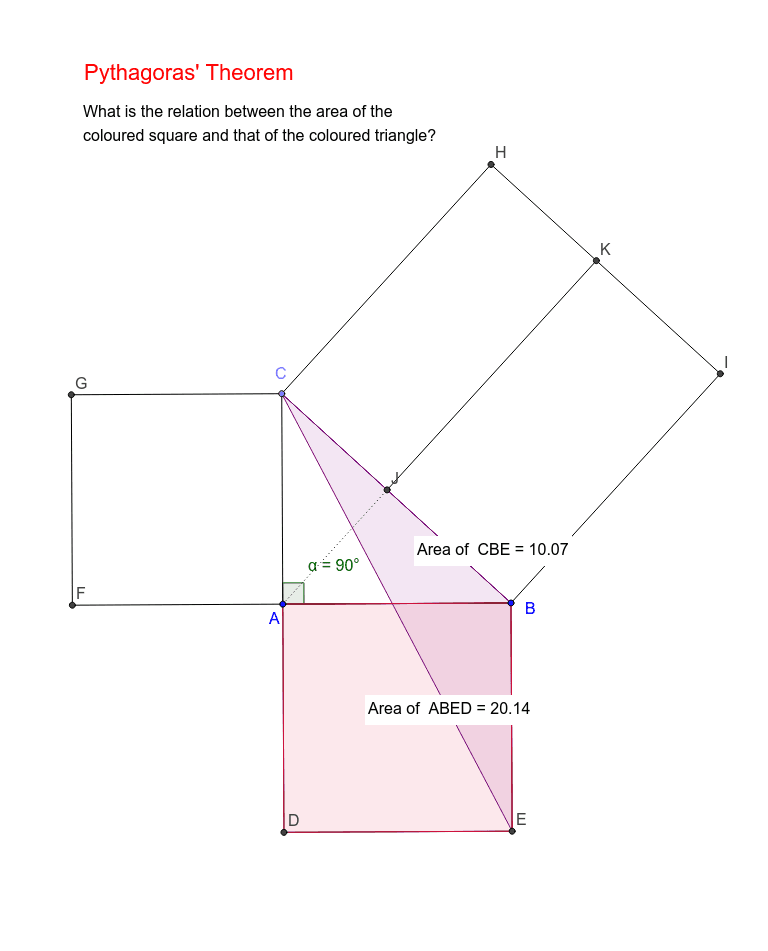
This example demonstrates the fourth part of Pythagoras' theorem, showing the relationship between the hypotenuse and the legs of a right triangle. Key mathematical concepts include right triangles and the application of Pythagoras' theorem. Using GeoGebra commands such as Segment, OrthogonalLine, and Point, a right triangle is constructed, and a polygon is drawn. Suitable for middle school and above students to learn geometric construction and Pythagoras' theorem.
GeoGebra Commands & Parameters
Segment(A, B) → aOrthogonalLine(A, a) → bPoint(b) → CSegment(C, A) → cSegment(C, B) → dAngle(B, A, C) → αCircle(B, A) → eCircle(A, B) → fOrthogonalLine(B, a) → gOrthogonalLine(A, a) → hIntersect(f, h, 1) → DIntersect(e, g, 1) → ESegment(D, E) → iSegment(B, A) → jSegment(A, D) → kSegment(E, B) → lCircle(A, C) → pCircle(C, A) → qOrthogonalLine(A, c) → mIntersect(p, m, 1) → FOrthogonalLine(C, c) → nIntersect(q, n, 1) → GOrthogonalLine(C, d) → rOrthogonalLine(B, d) → sCircle(B, C) → tCircle(C, B) → c_1Intersect(c_1, r, 2) → HIntersect(t, s, 2) → ISegment(B, I) → a_1Segment(I, H) → b_1Segment(H, C) → d_1Segment(C, G) → e_1Segment(F, A) → f_1Segment(F, G) → g_1OrthogonalLine(A, d) → h_1Intersect(h_1, d) → JIntersect(h_1, b_1) → KPolygon(J, K, H, C) → poly1, j_1, k_1, h_2, c_2Polygon(A, C, G, F) → poly2, a_2, c_3, g_2, f_2Segment(A, J) → i_1Polygon(J, B, I, K) → poly3, j_2, b_2, i_2, k_2Polygon(A, D, E, B) → poly4, a_3, d_2, e_2, b_3PointIn(poly1) → Pointpoly1PointIn(poly2) → Pointpoly2PointIn(poly3) → Pointpoly3PointIn(poly4) → Pointpoly4Segment(J, K) → l_1Polygon(C, B, E) → poly6, e_3, c_4, b_5Polygon(A, B, E, D) → poly5, a_4, b_4, e_4, d_3PointIn(poly5) → Pointpoly5PointIn(poly6) → Pointpoly6
AI Drawing Prompt Reference
Draw a right triangle to show the relationship between the hypotenuse and the legs. Construct a right triangle, mark the right-angle vertex, and draw the hypotenuse. Add two circles with the right-angle vertex as the center and radii equal to the leg lengths. Connect the circles with the hypotenuse to find intersection points. Finally, draw a polygon that includes these intersection points and the right-angle vertex to form a shape.
The prompt above was compiled from the original drawing commands and is for reference only.