
Complex Number Addition Demonstration
Loading the math board and drawing, please wait…
In collections
Algebra of complex numbers
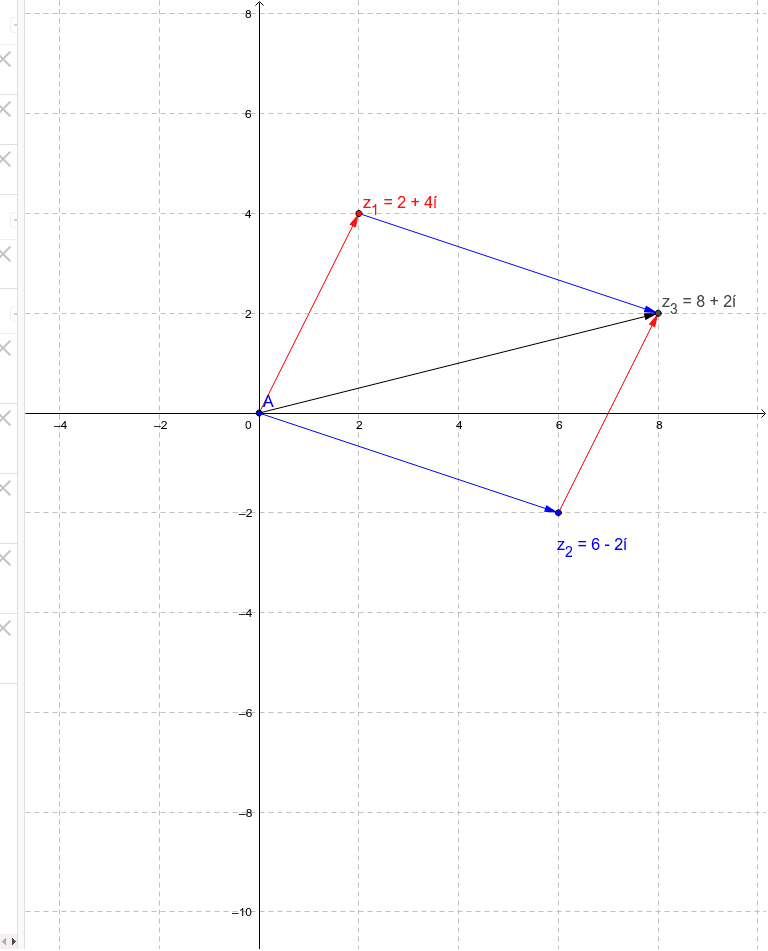
This example demonstrates the geometric interpretation of complex number addition, visually showing the sum of two complex numbers through vector addition. The core mathematical concepts involved include the geometric representation of complex numbers, vector addition, and the parallelogram law. The construction utilizes GeoGebra commands such as Intersect to find intersection points and Vector to create vectors. It is suitable for high school mathematics education, helping students understand the correspondence between algebraic and geometric operations of complex numbers.
GeoGebra Commands & Parameters
Intersect(xAxis, yAxis) → AVector(A, z_1) → uVector(A, z_2) → vVector(z_2, z_3) → wVector(z_1, z_3) → aVector(A, z_3) → b
AI Drawing Prompt Reference
Draw the geometric interpretation of complex number addition. Start by plotting point A at the intersection of the real and imaginary axes. Then, draw vectors u and v from A representing complex numbers z1 and z2, respectively. Next, draw vector w from z2 to z3 and vector a from z1 to z3, illustrating the parallelogram law of vector addition.
The prompt above was compiled from the original drawing commands and is for reference only.