
Pythagoras' Theorem Part 2
Loading the math board and drawing, please wait…
In collections
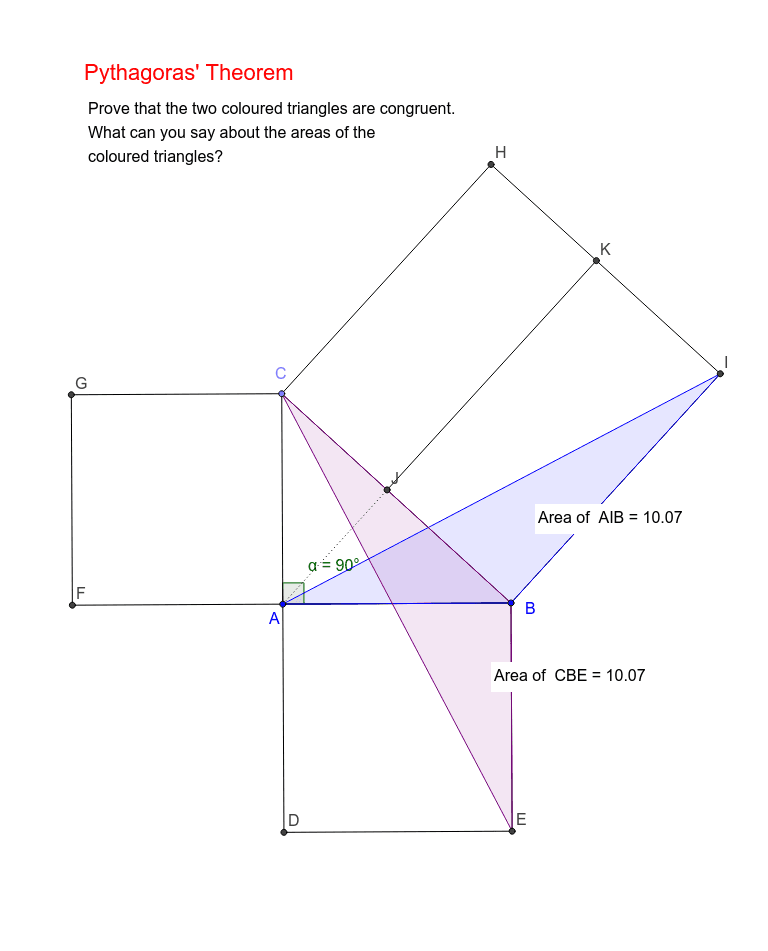
Euclid's proof of Pythagoras Theorem (proposition 47)
Pythagoras' theorem
Y10 Pythag & Trig
This example demonstrates the second part of Pythagoras' theorem by constructing the relationship between the sides of a right triangle. Key mathematical concepts include right triangles and Pythagoras' theorem. It uses GeoGebra commands such as Segment, OrthogonalLine, Point, Angle, Circle, Intersect, Polygon, and PointIn. Suitable for middle school and above students learning geometric construction.
GeoGebra Commands & Parameters
Segment(A, B) → aOrthogonalLine(A, a) → bPoint(b) → CSegment(C, A) → cSegment(C, B) → dAngle(B, A, C) → αCircle(B, A) → eCircle(A, B) → fOrthogonalLine(B, a) → gOrthogonalLine(A, a) → hIntersect(f, h, 1) → DIntersect(e, g, 1) → ESegment(D, E) → iSegment(B, A) → jSegment(A, D) → kSegment(E, B) → lCircle(A, C) → pCircle(C, A) → qOrthogonalLine(A, c) → mIntersect(p, m, 1) → FOrthogonalLine(C, c) → nIntersect(q, n, 1) → GOrthogonalLine(C, d) → rOrthogonalLine(B, d) → sCircle(B, C) → tCircle(C, B) → c_1Intersect(c_1, r, 2) → HIntersect(t, s, 2) → ISegment(B, I) → a_1Segment(I, H) → b_1Segment(H, C) → d_1Segment(C, G) → e_1Segment(F, A) → f_1Segment(F, G) → g_1OrthogonalLine(A, d) → h_1Intersect(h_1, d) → JIntersect(h_1, b_1) → KPolygon(J, K, H, C) → poly1, j_1, k_1, h_2, c_2Polygon(A, C, G, F) → poly2, a_2, c_3, g_2, f_2Segment(A, J) → i_1Polygon(J, B, I, K) → poly3, j_2, b_2, i_2, k_2Polygon(A, D, E, B) → poly4, a_3, d_2, e_2, b_3PointIn(poly1) → Pointpoly1PointIn(poly2) → Pointpoly2PointIn(poly3) → Pointpoly3PointIn(poly4) → Pointpoly4Segment(J, K) → l_1Polygon(A, I, B) → poly5, b_4, a_4, i_3Polygon(C, B, E) → poly6, e_3, c_4, b_5PointIn(poly5) → Pointpoly5PointIn(poly6) → Pointpoly6