
Pythagoras' Theorem --Area Dissection
Loading the math board and drawing, please wait…
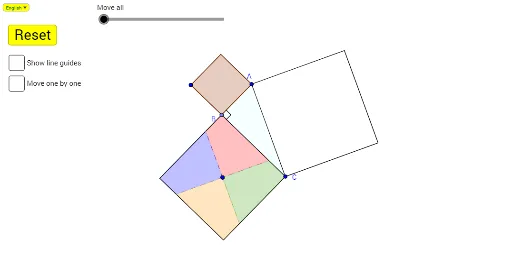
This example demonstrates a method of proving Pythagoras' Theorem through area dissection. Key mathematical concepts include area and the Pythagorean Theorem. The construction involves midpoints, circles, line segments, rotations, and intersections, illustrating the geometric construction process. Suitable for middle school and above students learning geometric proofs.
GeoGebra Commands & Parameters
Midpoint(A, C) → A_0Circle(A_0, C) → cPoint(c) → BSegment(A, C) → aSegment(C, B) → bSegment(B, A) → dRotate(B, 90°, C) → B_2Rotate(C, -90°, B) → B_1Rotate(B, -90°, A) → A_2Rotate(A, 90°, B) → A_1Rotate(A, -90°, C) → C_2Rotate(C, 90°, A) → C_1Segment(A, A_2) → eSegment(A_2, A_1) → fSegment(A_1, B) → gSegment(B, B_1) → hSegment(B_1, B_2) → iSegment(B_2, C) → jSegment(A, C_1) → kSegment(C_1, C_2) → lSegment(C_2, C) → mMidpoint(A, B_1) → DLine(D, a) → nIntersect(n, j) → EMidpoint(D, E) → FOrthogonalLine(F, n) → p_4Intersect(p_4, b) → GIntersect(p_4, i) → HSegment(D, E) → q_3Segment(H, G) → r_3Midpoint(C, A_1) → ILine(I, a) → s_3Intersect(s_3, e) → JMidpoint(J, I) → KOrthogonalLine(K, s_3) → t_3Segment(J, I) → a_1Intersect(t_3, f) → LIntersect(t_3, d) → MSegment(L, M) → b_1Distance(A, B) → ABDistance(B, C) → BCMin(AB, BC) → MinSIf(BC > AB, Distance[D, F], Distance[L, K]) → Len2Circle(C, Len2) → c_1Circle(C_1, Len2) → d_1Intersect(c_1, m, 1) → N_1Intersect(c_1, a, 1) → N_2Intersect(d_1, l, 1) → N_4Intersect(d_1, k, 1) → N_3Line(N_1, b) → e_1Line(N_2, d) → f_1Line(N_4, d) → g_1Line(N_3, b) → h_1Intersect(e_1, f_1) → O_1Intersect(e_1, g_1) → O_2Intersect(g_1, h_1) → O_3Intersect(f_1, h_1) → O_4Segment(N_1, O_1) → i_1Segment(N_2, O_4) → j_1Segment(N_3, O_3) → k_1Segment(N_4, O_2) → l_1Circle(C, Len2) → p_1Circle(C_1, Len2) → q_1Intersect(q_1, k, 1) → M_4Intersect(q_1, l, 1) → M_3Intersect(p_1, m, 1) → M_2Intersect(p_1, a, 1) → M_1Line(M_1, b) → m_1Line(M_3, b) → n_1Line(M_4, h) → r_1Line(M_2, j) → s_1Intersect(n_1, r_1) → P_4Intersect(n_1, s_1) → P_3Intersect(m_1, s_1) → P_2Intersect(m_1, r_1) → P_1Segment(M_3, P_4) → t_1Segment(M_4, P_1) → a_2Segment(M_1, P_2) → b_2Segment(M_2, P_3) → c_2Circle(Q_1, Len2) → d_2Line(Q_1, m) → e_2Line(Q_1, a) → f_2Intersect(d_2, f_2, 1) → Q_2Intersect(d_2, e_2, 1) → Q_3Line(Q_3, b) → g_2Line(Q_2, b) → h_2Line(Q_2, d) → i_2Line(Q_3, d) → j_2Intersect(g_2, i_2) → Q_4Intersect(h_2, j_2) → Q_5If(BC > AB, Polygon[Q_1, Q_3, Q_4, Q_2], Polygon[Q_1, Q_2, Q_5, Q_3]) → RedPolyCircle(R_1, Len2) → k_2Line(R_1, a) → l_2Line(R_1, m) → m_2Intersect(k_2, l_2, 1) → R_2Intersect(k_2, m_2, 2) → R_3Line(R_2, d) → n_2Line(R_3, d) → p_2Line(R_2, b) → q_2Line(R_3, b) → r_2Intersect(p_2, q_2) → R_4Intersect(n_2, r_2) → R_5If(BC > AB, (Polygon[R_1, R_2, R_5, R_3] * Polygon[R_1, R_3, R_4, R_5])) → oIf(BC > AB, Polygon[R_1, R_2, R_5, R_3], Polygon[R_1, R_3, R_4, R_2]) → BluePolyCircle(S_1, Len2) → s_2Line(S_1, a) → t_2Line(S_1, m) → a_3Intersect(s_2, a_3, 2) → S_2Intersect(s_2, t_2, 2) → S_3Line(S_2, b) → b_3Line(S_3, b) → c_3Line(S_2, d) → d_3Line(S_3, d) → e_3Intersect(c_3, d_3) → S_5Intersect(b_3, e_3) → S_4If(BC > AB, Polygon[S_1, S_2, S_4, S_3], Polygon[S_1, S_3, S_5, S_2]) → AmberPolyCircle(T_1, Len2) → f_3Line(T_1, a) → g_3Line(T_1, m) → h_3Intersect(f_3, h_3, 1) → T_2Intersect(f_3, g_3, 2) → T_3Line(T_2, d) → i_3Line(T_3, d) → j_3Line(T_3, b) → k_3Line(T_2, b) → l_3Intersect(j_3, l_3) → T_4Intersect(i_3, k_3) → T_5If(BC > AB, Polygon[T_1, T_3, T_4, T_2], Polygon[T_1, T_2, T_5, T_3]) → GreenPolyCircle(U_1, MinS) → p_3Line(U_1, g) → m_3Intersect(p_3, m_3, 2) → U_2Rotate(U_2, 90°, U_1) → U_3Rotate(U_1, -90°, U_2) → U_4Polygon(U_3, U_1, U_2, U_4) → poly1, u_3, u_1, u_2, u_4Vector(Q_1, C) → pVector(R_1, C_2) → qVector(S_1, C_1) → rVector(T_1, A) → sTranslate(RedPoly, p_t) → RedPoly'Translate(BluePoly, q_t) → BluePoly'Translate(AmberPoly, r_t) → AmberPoly'Translate(GreenPoly, s_t) → GreenPoly'Vector(U_1, O_1) → uVector(U_1, P_1) → vIf(BC > AB, Vector[(Brown * u)], Vector[(Brown * v)]) → u_tTranslate(U_3, u_t) → NTranslate(U_1, u_t) → OTranslate(U_2, u_t) → PTranslate(U_4, u_t) → QPolygon(N, O, P, Q) → poly1', n_3, o_1, p_5, q_4Polygon(A, B, C) → poly2, c_4, a_4, b_4Circle(B, S90) → d_4Intersect(d_4, b, 1) → RIntersect(d_4, d, 1) → SRotate(B, -90°, R) → B'Segment(S, B') → e_4Segment(B', R) → f_4Translate(RedPoly, v_1) → RedPoly'_1Translate(BluePoly, v_2) → BluePoly'_1Translate(AmberPoly, v_3) → AmberPoly'_1Translate(GreenPoly, v_4) → GreenPoly'_1If(BC > AB, Vector[(Rearrange * u)], Vector[(Rearrange * v)]) → v_tTranslate(U_3, v_t) → TTranslate(U_1, v_t) → UTranslate(U_2, v_t) → VTranslate(U_4, v_t) → WPolygon(T, U, V, W) → poly1'_1, t_4, u_5, v_5, w_1SelectedIndex(Bahasa) → nn
AI Drawing Prompt Reference
Draw a right triangle ABC with A as the right angle vertex, B as the hypotenuse vertex, and C as the base vertex. Use midpoints, circles, rotations, and intersections to demonstrate the area dissection proof of Pythagoras' Theorem. Start by drawing points A and C, then draw line segment AC. Construct the midpoint A0 of AC and draw circle c with A0 as the center, which intersects AC at point B. Next, draw line segments AB, BC, and CA. Use rotations and intersections to construct a series of auxiliary line segments and points, ultimately proving Pythagoras' Theorem through these auxiliary elements.
The prompt above was compiled from the original drawing commands and is for reference only.