
Pyramid Volume Conjecture Demo by kadhem ghazouani
Loading the math board and drawing, please wait…
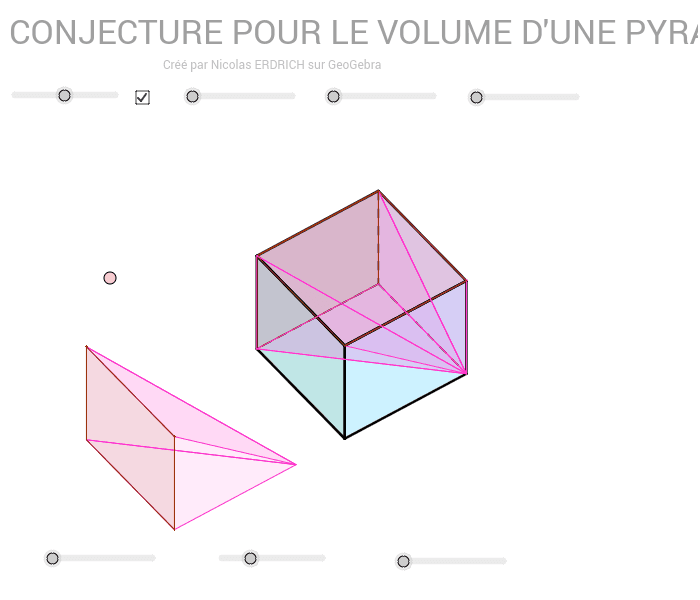
This example demonstrates the conjecture and verification of the pyramid volume formula. It involves core math concepts like solid geometry, volume calculation, and trigonometric applications. Construction highlights include using commands like Sequence, Element, Point, Polygon, Segment, PointIn, Translate to create a dynamic pyramid model. Suitable for high school geometry instruction and exploratory learning.
GeoGebra Commands & Parameters
Sequence(Mat * Element[cube, k], k, 1, 8) → cube'Element(Element[AE, 3], 1) → droiteSequence((Element[cube', k, 1, 1], Element[cube', k, 2, 1]), k, 1, 8) → listepointsPoint(listepoints) → APoint(listepoints) → EPoint(listepoints) → C_1Point(listepoints) → DPolygon(A, E, C_1, D) → poly1, a_1, b, c_1, dPoint(listepoints) → BPoint(listepoints) → FPoint(listepoints) → GPoint(listepoints) → HPolygon(B, F, G, H) → poly2, e, f, g, hPoint(listepoints) → CPolygon(F, C, A, B) → poly3, f_1, i, a_2, b_1Element(AB, 3, 1) → avantPolygon(C_1, G, H, E) → poly4, c_2, g_1, h_1, e_1Element(AC, 3, 1) → dessusPolygon(F, C, C_1, G) → poly5, f_2, c_3, c_4, g_2Polygon(A, B, H, E) → poly6, a_3, b_2, h_2, e_2Segment(E, A) → cSegment(A, C) → jSegment(A, B) → kSegment(C, C_1) → lSegment(C_1, E) → mSegment(H, E) → nSegment(A, B) → pSegment(B, H) → qSegment(H, E) → rSegment(H, G) → sSegment(B, F) → tSegment(G, C_1) → d_1Segment(F, G) → i_1Segment(F, C) → j_1PointIn(poly5) → JTranslate(J, Vector[val1 * Vector[A, B]]) → pyr1_1Translate(A, Vector[val1 * Vector[A, B]]) → pyr1_2Translate(B, Vector[val1 * Vector[A, B]]) → pyr1_3Translate(H, Vector[val1 * Vector[A, B]]) → pyr1_4Translate(E, Vector[val1 * Vector[A, B]]) → pyr1_5Polygon(pyr1_1, pyr1_2, pyr1_3) → poly11, pyr1_6, pyr1_7, pyr1_8Polygon(pyr1_1, pyr1_3, pyr1_4) → poly12, pyr1_9, pyr1_{10}, pyr1_{11}Polygon(pyr1_5, pyr1_1, pyr1_2) → poly13, pyr1_{12}, pyr1_{13}, pyr1_{14}Polygon(pyr1_5, pyr1_4, pyr1_3, pyr1_2) → poly14, pyr1_{15}, pyr1_{16}, pyr1_{17}, pyr1_{18}Translate(J, Vector[val2 * Vector[A, E]]) → pyr2_1Translate(E, Vector[val2 * Vector[A, E]]) → pyr2_2Translate(H, Vector[val2 * Vector[A, E]]) → pyr2_3Translate(C_1, Vector[val2 * Vector[A, E]]) → pyr2_4Translate(G, Vector[val2 * Vector[A, E]]) → pyr2_5Polygon(pyr2_1, pyr2_2, pyr2_3) → poly15, pyr2_6, pyr2_7, pyr2_8Polygon(pyr2_1, pyr2_4, pyr2_5) → poly16, pyr2_9, pyr2_{10}, pyr2_{11}Polygon(pyr2_1, pyr2_3, pyr2_5) → poly17, pyr2_{12}, pyr2_{13}, pyr2_{14}Polygon(pyr2_4, pyr2_2, pyr2_3, pyr2_5) → poly18, pyr2_{15}, pyr2_{16}, pyr2_{17}, pyr2_{18}Translate(J, Vector[val3 * Vector[D, A]]) → pyr3_1Translate(F, Vector[val3 * Vector[D, A]]) → pyr3_2Translate(B, Vector[val3 * Vector[D, A]]) → pyr3_3Translate(G, Vector[val3 * Vector[D, A]]) → pyr3_4Translate(H, Vector[val3 * Vector[D, A]]) → pyr3_5Polygon(pyr3_1, pyr3_3, pyr3_2) → poly19, pyr3_6, pyr3_7, pyr3_8Polygon(pyr3_2, pyr3_4, pyr3_5, pyr3_3) → poly20, pyr3_9, pyr3_{10}, pyr3_{11}, pyr3_{12}Polygon(pyr3_1, pyr3_2, pyr3_4) → poly21, pyr3_{13}, pyr3_{14}, pyr3_{15}Polygon(pyr3_1, pyr3_5, pyr3_4) → poly22, pyr3_{16}, pyr3_{17}, pyr3_{18}
AI Drawing Prompt Reference
Draw a regular square pyramid with base ABCD and apex E. Connect apex E to each vertex of the base to form four triangles. Translate the base ABCD downward to form an inverted pyramid with apex E. Then translate the base upward to form a regular pyramid with apex E. Finally, translate the base to the sides of apex E to form two side faces.
The prompt above was compiled from the original drawing commands and is for reference only.