
Proving Triangles Similar Using Geometric Transformations (Exercise 1) (1)
Loading the math board and drawing, please wait…
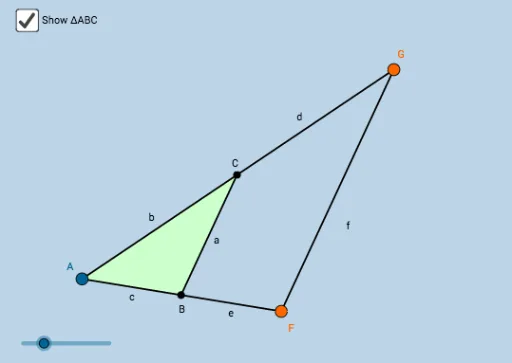
① This example demonstrates how to prove two triangles are similar by mapping one onto the other using geometric transformations such as translation, rotation, reflection, and dilation. ② The core mathematical concepts include similarity criteria for triangles and the properties of transformations that preserve angles and ratios, with applications of trigonometric functions like sine and tangent in angle calculations. ③ Construction highlights: based on the construction summary, the GeoGebra commands used include Ray, Rotate, Angle, Point, Segment, Polygon, Line, and Intersect, creating multiple triangles (poly1, poly2) and auxiliary lines, and constructing corresponding points via rotations and dilations. ④ This is suitable for high school geometry students learning similarity and transformations, and for teachers to demonstrate the connection between transformations and similarity in class.
GeoGebra Commands & Parameters
Ray(A, F) → f_1Rotate(F, (a_3 * π / 180), A) → B'Angle(F, A, B') → αRay(A, B') → gPoint(g) → GSegment(G, F) → fSegment(A, F) → iPolygon(A, F, G) → poly1, c_1, a_1, b_1Segment(A, G) → jAngle(G, F, A) → βPoint(j) → DLine(D, f) → kIntersect(k, i) → ESegment(D, E) → aPolygon(A, E, D) → poly2, d_1, a_2, e_1Intersect(a, j) → CIntersect(i, xAxis) → G_1Intersect(a, i) → BSegment(A, C) → bSegment(C, G) → dSegment(A, B) → cSegment(B, F) → e
AI Drawing Prompt Reference
Start with a ray from point A through point F. Rotate point F around A by a certain angle to get a new point, and draw another ray from A through this rotated point. Pick a point G on this second ray, and connect G to F to form triangle AFG. Choose a point D on side AG, draw a line through D parallel to FG, intersecting AF at E, forming triangle ADE. Connect remaining segments to show the two triangles are similar, marking all intersection points.
The prompt above was compiled from the original drawing commands and is for reference only.