
Angles and Steepness Practice: Similar Right Triangles to Read Slope
Loading the math board and drawing, please wait…
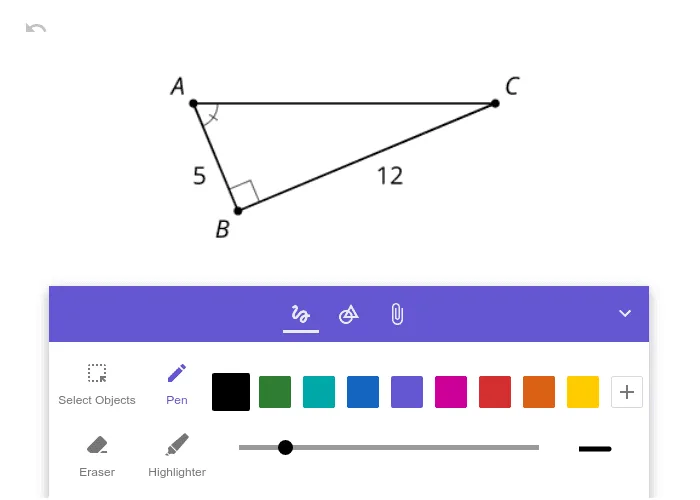
This GeoGebra example demonstrates how to connect the visual notion of “angles” with “steepness” (a slope-like rise/run ratio) by using geometric ratios. The key ideas include right triangles, measuring and relating angles, and using similar triangles to transfer proportional relationships between corresponding sides. It also leverages similarity transformations (similarity mapping / similarity transformation) to reproduce an analogous triangle structure, enabling consistent deduction of steepness from constructed geometry. Construction-wise, the model relies on defining rays/lines and using angle measurement to set the key angle(s), building right triangles that share the same angle structure, and then applying similarity/scale-based transformation to align corresponding sides. From these corresponding sides, the steepness is obtained as an appropriate ratio (often interpreted via the tangent relationship). Suitable for secondary education through early pre-calculus, and useful for lessons that connect Euclidean geometry with slope, trigonometry, and ratio reasoning.
AI Drawing Prompt Reference
Draw a right triangle and then create another right triangle by adjusting the angle to be similar. Measure and label the corresponding angles of the two triangles. Use similarity transformation to adjust the side lengths of one triangle so that the ratios of corresponding sides are the same. Calculate the ratio of corresponding sides to find the slope.
The prompt above was compiled from the original drawing commands and is for reference only.