
Proving Triangles Similar (4)
Loading the math board and drawing, please wait…
In collections
Similar Triangles Book APS 10/27/18
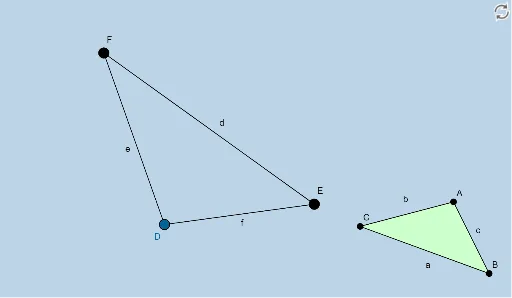
This example demonstrates how to prove triangle similarity through construction and transformation; involves core concepts like triangle similarity criteria, geometric transformations, and vector operations; constructed using GeoGebra commands such as Ray, Rotate, Angle, Point, Segment, Polygon, Line, Intersect, Mirror, and Dilate; suitable for high school mathematics teaching and geometric transformation learning.
GeoGebra Commands & Parameters
Ray(D, E) → f_2Rotate(E, (a_2 * π / 180), D) → B'Angle(E, D, B') → αRay(D, B') → gPoint(g) → FSegment(F, E) → dSegment(D, E) → fPolygon(D, E, F) → poly1, c_1, a_1, b_1Segment(D, F) → eAngle(F, E, D) → βPoint(e) → D_1Line(D_1, d) → kIntersect(k, f) → E_1Line(I, J) → nMirror(E_1, n) → E'Mirror(D_1, n) → D'Mirror(D, n) → A'Mirror(E, n) → B'_1Mirror(F, n) → C'Polygon(A', B'_1, C') → poly1', c', a', b'_1Rotate(A', (m * π / 180), A') → ARotate(B'_1, (m * π / 180), A') → F_1Rotate(C', (m * π / 180), A') → C''Polygon(A, F_1, C'') → poly1'', c'', a'', f_1Dilate(A, d_1, A) → A'''Dilate(F_1, d_1, A) → BDilate(C'', d_1, A) → CPolygon(A''', B, C) → poly1''', c''', a''', f'Segment(A, C) → bSegment(A, B) → cSegment(B, C) → a