
Exploring Rotations on the Coordinate Plane
Loading the math board and drawing, please wait…
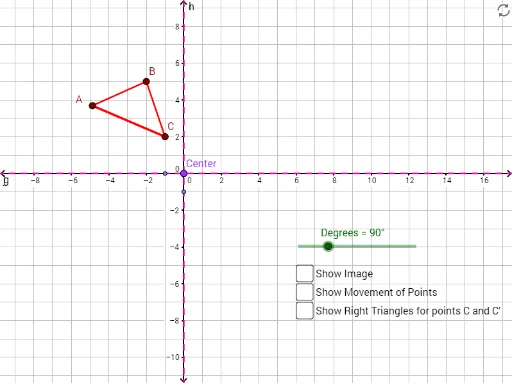
This example demonstrates how to perform rotations on the coordinate plane. By rotating triangles or other polygons, one can visually understand the concept of rotation and its effect on shapes. Key math concepts involved include rotation, coordinate geometry, angles, and transformation. Construction highlights the use of GeoGebra commands such as Polygon, Rotate, CircleArc, and Line to create and manipulate shapes. Suitable for middle school students and above to learn about the properties and applications of rotational transformations.
GeoGebra Commands & Parameters
Polygon(A, B, C) → poly1, c, a, bRotate(A, Degrees, Center) → A'Rotate(B, Degrees, Center) → B'Rotate(C, Degrees, Center) → C'Polygon(A', B', C') → poly1', c', a', b'CircleArc(Center, C, C') → dCircleArc(Center, B, B') → eCircleArc(Center, A, A') → fLine(D, E) → gLine(F, G) → hLine(F, G) → iLine(E, D) → jLine(Center, j) → kLine(Center, i) → lPolygon(Center, H, C) → poly2, c_1, center, h_1Rotate(Center, Degrees, Center) → Center'Rotate(H, Degrees, Center) → H'Rotate(C, Degrees, Center) → C'_1Polygon(Center', H', C'_1) → poly2', c'_1, center', h'
AI Drawing Prompt Reference
Draw a triangle ABC, then rotate it 90 degrees around a center point to create a new triangle A'B'C'. Next, draw circular arcs connecting the endpoints of A', B', and C', and use these arcs to form two lines. Finally, draw two parallel lines through the center point, corresponding to these lines.
The prompt above was compiled from the original drawing commands and is for reference only.