
Proving Theorems: Interactive Geometry with Circles, Sectors, and Vector Transfo
Loading the math board and drawing, please wait…
In collections
Congruence Review 1
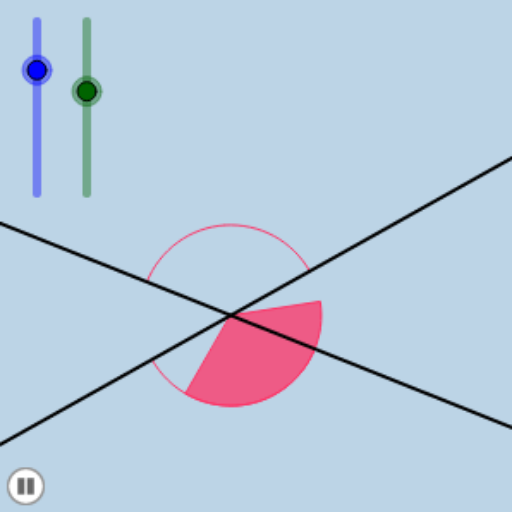
This GeoGebra example demonstrates how to construct and prove geometric theorems using dynamic geometry tools, focusing on circles, sectors, angles, and vector transformations. The core mathematical concepts include properties of circles and sectors, angle relationships, vector operations, and geometric transformations such as rotation, translation, and dilation. The construction uses commands like Point, Rotate, Angle, Line, Circle, Intersect, CircleSector, Dilate, Vector, Translate, and CircleArc, creating multiple points, lines, circles, sectors, and vectors to interactively illustrate the theorem's validity. It is suitable for high school or early college students to explore and verify geometric theorems visually, and for teachers to use as a dynamic demonstration tool in class, enhancing understanding of proof logic and construction methods.
GeoGebra Commands & Parameters
Point(a) → BRotate(B, α, A) → B'Angle(B, A, B') → βLine(A, B') → bCircle(A, 1) → eIntersect(b, d) → CCircle(C, 1) → fIntersect(e, a) → D, EIntersect(e, b) → F, GIntersect(f, b) → H, IIntersect(f, d) → J, KCircleSector(C, K, I) → gCircleSector(C, I, J) → hCircleSector(A, D, F) → sCircleSector(A, F, E) → tDilate(A, If[0 < i < 1, 1 - i], C) → A'Vector(A, A') → uTranslate(s, u) → s'Translate(t, u) → t'CircleArc(C, K, I) → d_1CircleArc(C, I, J) → e_1CircleArc(A, D, F) → g_1CircleArc(A, F, E) → k_1Rotate(t', ((i * 180))°, A') → t''Rotate(s', If[0 < i ≤ 1, (i * π), π], A') → s''
AI Drawing Prompt Reference
Create a dynamic geometry illustration showing the proof of theorems involving circles, sectors, and vector transformations. Start by drawing a circle and a point, then rotate the point and measure the angle. Draw lines and circles based on intersections. Construct additional circles and sectors using these intersections to demonstrate angle relationships and vector operations. Finally, apply transformations like dilation, translation, and rotation to dynamically illustrate the validity of geometric theorems.
The prompt above was compiled from the original drawing commands and is for reference only.