
Proving Segment Congruence via Transformational Geometry
Loading the math board and drawing, please wait…
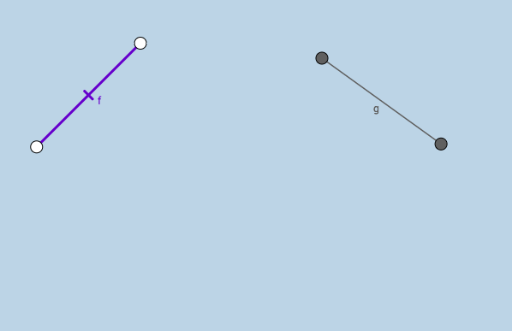
This interactive GeoGebra exercise demonstrates how to prove two segments congruent using rotations and translations, built around a kite-shaped configuration. It visually shows that after applying a rotation and a translation, corresponding segments remain equal in length, reinforcing the concept of congruence. Core mathematical concepts include congruence, rotation, translation, area relationships, and trigonometric functions, with step functions possibly controlling the animation sequence. The construction uses GeoGebra commands such as Point, Segment, Max, PointIn, and Circle, creating objects A, B, f, a, b, C, c, D, and g. Points are placed on circles and intersections to define transformed positions, while Max and PointIn help manage dynamic constraints. This resource is ideal for middle or high school geometry classes, enabling students to explore transformation-based proofs, understand the properties of rigid motions, and engage in hands-on dynamic geometry investigation.
GeoGebra Commands & Parameters
Point(xAxis) → ASegment(A, B) → fMax(x(A), x(B)) → aPointIn(b) → CCircle(C, f) → cPoint(c) → DSegment(C, D) → g