
Properties of Trapezoids by tmoorehead
Loading the math board and drawing, please wait…
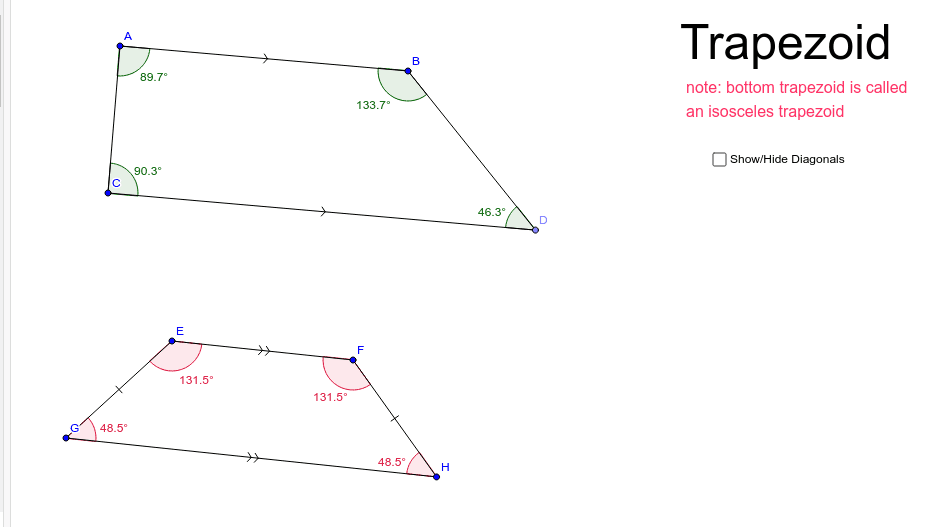
This GeoGebra example dynamically illustrates the fundamental properties of trapezoids, including parallel bases, leg relationships, diagonal properties, and angle relations. Core mathematical concepts covered include the definition of a trapezoid, properties of parallel lines, symmetry in isosceles trapezoids, angle bisectors, and perpendicular bisectors. The construction uses GeoGebra commands such as Segment, Line, Point, Angle, LineBisector, Mirror, and Intersect to build trapezoid ABCD and generate auxiliary elements like angle bisectors, axes of symmetry, and diagonal intersection points, visually demonstrating that consecutive interior angles are supplementary and the segment connecting diagonal midpoints is parallel to the bases. Suitable for middle school geometry instruction, this resource supports classroom demonstrations or student-led exploration, helping learners understand the connections between trapezoids, parallel lines, and symmetry, and laying groundwork for area calculations and similar triangles.
GeoGebra Commands & Parameters
Segment(A, B) → aLine(C, a) → bPoint(b) → DSegment(A, C) → cSegment(B, D) → dSegment(C, D) → eAngle(C, A, B) → αAngle(A, B, D) → βAngle(B, D, C) → γAngle(D, C, A) → δSegment(E, F) → fLine(G, f) → gLineBisector(f) → hSegment(E, G) → iMirror(E, h) → E'Mirror(G, h) → HSegment(E', H) → i'Segment(G, H) → jAngle(G, E, F) → εAngle(E, F, H) → ζAngle(F, H, G) → ηAngle(H, G, E) → θSegment(E, H) → kSegment(F, G) → lSegment(A, D) → mSegment(C, B) → nIntersect(m, n) → IIntersect(k, l) → JSegment(A, I) → pSegment(I, D) → qSegment(I, B) → rSegment(I, C) → sSegment(E, J) → tSegment(F, J) → uSegment(J, H) → vSegment(J, G) → wAngle(G, J, H) → ιAngle(C, I, D) → κ