
Properties of Tangents to Circles Interactive Investigation
Loading the math board and drawing, please wait…
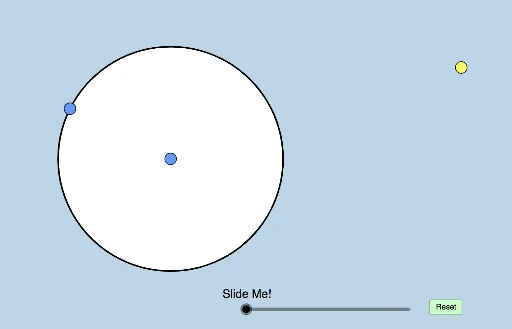
This example demonstrates how to explore the properties of tangents to circles through interactive operations. Key math concepts involved include tangent lines, circles, angles, similar triangles, and the Pythagorean theorem. Construction highlights the use of GeoGebra commands and objects such as Circle, Segment, PointIn, Tangent, Intersect, Ray, Dilate, Angle, Rotate, CircleSector, and Line. Suitable for high school students to understand geometric properties of circles and conduct exploratory learning.
GeoGebra Commands & Parameters
Circle(O, B_1) → cSegment(O, B_1) → aPointIn(b) → ETangent(E, c) → d, eIntersect(c, e, 1) → BIntersect(c, d, 1) → ARay(E, A) → fRay(E, B) → gSegment(O, A) → hSegment(O, B) → iDilate(O, If[0 < j ≤ 1, 1 - j, 0], A) → A'Dilate(O, If[0 < j ≤ 1, 1 - j, 0], B) → A'_1Segment(O, A') → kSegment(O, A'_1) → lAngle(E, B, O) → αAngle(O, A, E) → βCircle(A, (0.25 * a)) → pCircle(B, (0.25 * a)) → qIntersect(p, h, 1) → FIntersect(q, i, 1) → GIntersect(p, f) → H, IIntersect(q, g) → J, KCircle(O, B_1) → tDilate(O, If[3.6 < j ≤ 4.6, 4.6 - j, 0], E) → C'Angle(A, E, B) → γRotate(B, If[5 < j ≤ 6, ((j - 5) * ((2 * π) - γ)), (2 * π) - γ], E) → D'_1Rotate(E, If[5 < j ≤ 6, ((j - 5) * ((2 * π) - γ)), (2 * π) - γ], E) → C'_1Segment(E, A) → nRay(A, I) → mRay(B, K) → g_1Rotate(E, If[5 < j ≤ 6, ((j - 5) * (-γ)), (-γ)], E) → C'_2Rotate(B, If[5 < j ≤ 6, ((j - 5) * (-γ)), (-γ)], E) → D'Rotate(I, If[1.5 < j ≤ 2.5, ((j - 1.5) * π / 2), π / 2], A) → I'Rotate(K, If[1.5 < j ≤ 2.5, ((-(j - 1.5)) * π / 2), ((-π)) / 2], B) → K'CircleSector(A, I, I') → rCircleSector(B, K', K) → sRotate(r, If[3.25 < j ≤ 4.25, ((j - 3.25) * π / 2), π / 2], A) → r'Rotate(s, If[3.25 < j ≤ 4.25, ((-(j - 3.25)) * π / 2), ((-π)) / 2], B) → s'Dilate(E, If[-1 < j ≤ 0, (-j), 0], A) → E'Dilate(E, If[-1 < j ≤ 0, (-j), 0], B) → E'_1Segment(E, E'_1) → f_1Segment(E, E') → i_1Line(E, A) → j_1Line(E, B) → k_1Circle(B, 2) → p_1Circle(A, 2) → q_1Intersect(q_1, j_1) → C, DIntersect(p_1, k_1) → L, MRay(A, D) → l_1Ray(B, M) → m_1Rotate(E, If[4.75 < j ≤ 5.75, ((j - 4.75) * γ), γ], E) → E'_2Rotate(E', If[4.75 < j ≤ 5.75, ((j - 4.75) * γ), γ], E) → E''Segment(E'_2, E'') → n_1