
Properties of a Trapezium: Sides, Angles, Diagonals, and Midsegment
Loading the math board and drawing, please wait…
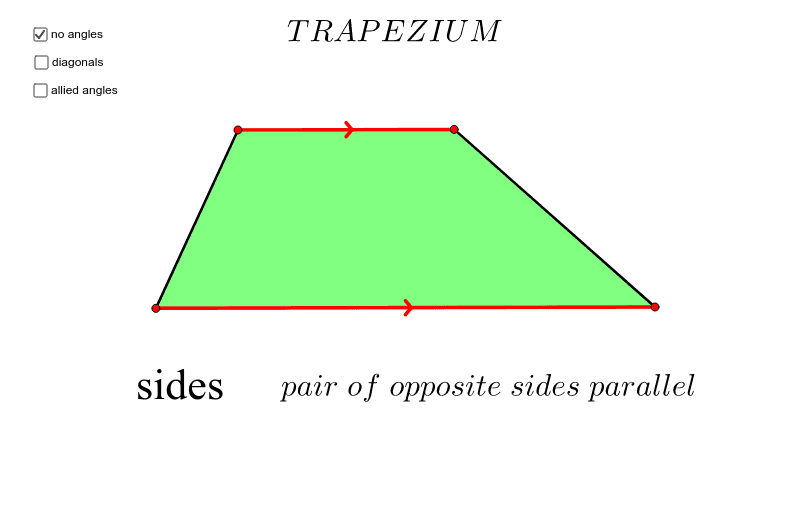
① This interactive GeoGebra construction demonstrates the fundamental properties of a trapezium (trapezoid), including parallel bases, relationships among legs, intersection of diagonals, the midsegment (median) length, and supplementary interior angles. ② Core mathematical concepts covered: definition of a trapezium (one pair of parallel sides), properties of isosceles trapezium, midsegment theorem, angle relations with parallel lines, and geometric measurements of lengths and angles. ③ Construction details: Based on the summary, the construction uses GeoGebra commands such as Segment, Line, Point, Polygon, Midpoint, OrthogonalLine, Intersect, and Angle, creating vertices A, B, C, D, auxiliary points P, E, F, L, multiple segments and angle markers, with text objects displaying measurements. ④ Suitable for middle school to high school students learning plane geometry, useful for classroom demonstrations or self-exploration of trapezium properties, and as a practice example for geometric construction.
GeoGebra Commands & Parameters
Segment(A, B) → a_2Line(C, a_2) → b_2Point(b_2) → DPolygon(A, C, D, B) → P, a_1, a, d, bMidpoint(D, B) → ELine(A, B) → eOrthogonalLine(D, e) → fIntersect(f, e) → FMidpoint(a_2) → LSegment(A, D) → cSegment(C, B) → gAngle(B, C, D) → αAngle(C, B, A) → βAngle(C, D, A) → γAngle(B, A, D) → δAngle(A, C, D) → εAngle(C, D, B) → ζAngle(D, B, A) → ηAngle(B, A, C) → θ