
Properties of a Rhombus: Sides, Angles, Diagonals and Symmetry
Loading the math board and drawing, please wait…
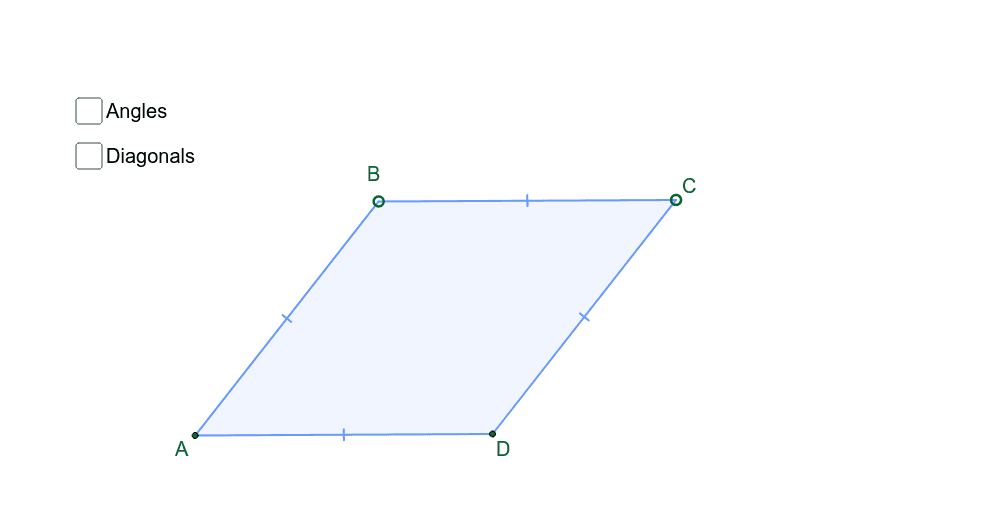
This GeoGebra example dynamically demonstrates the fundamental properties of a rhombus, including equal side lengths, opposite angles equal, adjacent angles supplementary, and diagonals that are perpendicular bisectors of each other and bisect the vertex angles. The core mathematical concepts involve special quadrilaterals, symmetry, angle relationships, and geometric construction. The construction uses commands such as Segment, Midpoint, OrthogonalLine, Point, Mirror, Polygon, and Angle to build the rhombus with its diagonals and labeled vertices and angles. It is suitable for middle school geometry lessons or student self-exploration, and also useful for high school review of rhombus properties. The interactive nature allows users to drag vertices and observe invariant properties, reinforcing understanding of geometric theorems.
GeoGebra Commands & Parameters
Segment(A, C) → aMidpoint(a) → XOrthogonalLine(X, a) → bPoint(b) → BMirror(B, a) → DPolygon(A, B, C, D) → poly1, a_1, d, b_1, d'Segment(A, X) → cSegment(X, C) → eSegment(B, X) → fSegment(X, D) → gAngle(A, B, C) → αAngle(B, C, D) → βAngle(C, D, A) → γAngle(D, A, B) → δAngle(A, X, D) → εAngle(A, B, X) → ζAngle(X, B, C) → ηAngle(B, C, X) → θAngle(X, C, D) → ιAngle(C, D, X) → κAngle(X, D, A) → λAngle(D, A, X) → μAngle(X, A, B) → ν
AI Drawing Prompt Reference
Draw a rhombus by first creating a diagonal, then constructing a perpendicular bisector through its midpoint. Pick a point on this perpendicular line as one vertex, reflect it across the diagonal to get the opposite vertex, and connect all four vertices to form the rhombus. Draw both diagonals and the four half-diagonals from their intersection. Label the four interior angles and the eight angles formed by the diagonals, illustrating equal sides, equal opposite angles, supplementary adjacent angles, and perpendicular bisecting diagonals.
The prompt above was compiled from the original drawing commands and is for reference only.