
Properties of a Rhombus by tmoorehead (2)
Loading the math board and drawing, please wait…
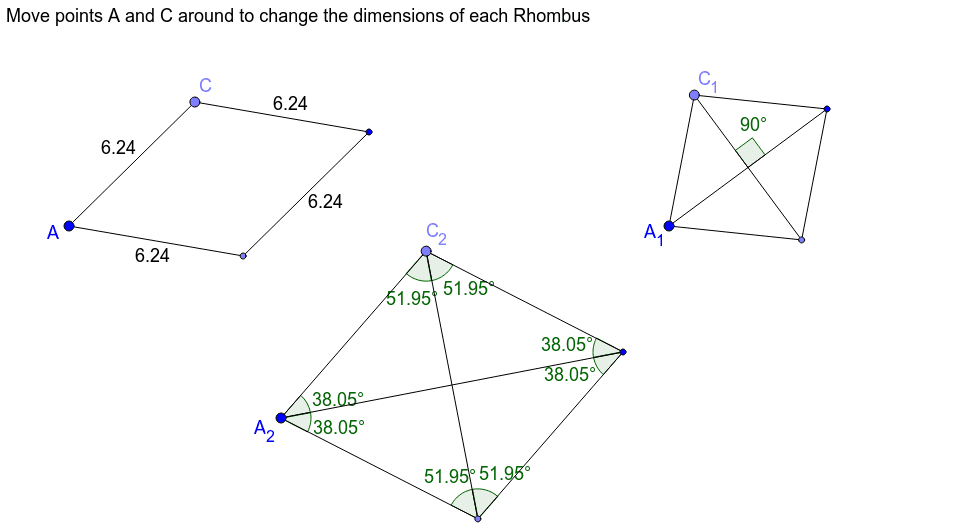
① This example dynamically demonstrates the definition and core properties of a rhombus, including equal side lengths, perpendicular bisecting diagonals, and equal opposite angles. ② Key mathematical concepts include rhombus, similarity transformation, symmetry, angle relationships, and geometric measurement. ③ Construction highlights: using GeoGebra commands such as Line, LineBisector, Point, Mirror, Segment, and Angle, multiple rhombi and their mirrored copies are constructed, illustrating invariant properties under similarity transformations; objects include points A, B, C, segments a, b, c, and angles α, β, γ, etc. ④ Suitable for middle school geometry classes or high school review, providing an intuitive exploration of rhombus properties and symmetry, and serving as an example for dynamic geometry investigations.
GeoGebra Commands & Parameters
Line(A, B) → aLineBisector(A, B) → bPoint(b) → CMirror(C, a) → C'Segment(C', A) → cSegment(A, C) → dSegment(C, B) → eSegment(B, C') → fLine(A_1, B_1) → a_1LineBisector(A_1, B_1) → b_1Point(b_1) → C_1Mirror(C_1, a_1) → C'_1Segment(C'_1, A_1) → c_1Segment(A_1, C_1) → d_1Segment(C_1, B_1) → e_1Segment(B_1, C'_1) → f_1Line(A_2, B_2) → a_2LineBisector(A_2, B_2) → b_2Point(b_2) → C_2Mirror(C_2, a_2) → C'_2Segment(C'_2, A_2) → c_2Segment(A_2, C_2) → d_2Segment(C_2, B_2) → e_2Segment(B_2, C'_2) → f_2Segment(A_1, B_1) → gSegment(C'_1, C_1) → hAngle(h, g) → αSegment(C_2, C'_2) → iSegment(A_2, B_2) → jAngle(C_2, B_2, A_2) → βAngle(C'_2, B_2, A_2) → γAngle(B_2, C'_2, C_2) → δAngle(C_2, C'_2, A_2) → εAngle(C'_2, A_2, B_2) → ζAngle(B_2, A_2, C_2) → ηAngle(A_2, C_2, C'_2) → θAngle(C'_2, C_2, B_2) → ι
AI Drawing Prompt Reference
Draw three rhombi. For each, start with a segment, construct its perpendicular bisector, place a point on the bisector, reflect that point across the segment, and connect the four vertices to form the rhombus. The first rhombus shows the basic shape. The second labels one pair of opposite sides and one angle. The third labels all interior angles and shows the diagonals intersecting perpendicularly. Illustrate equal side lengths, equal opposite angles, and perpendicular bisecting diagonals, demonstrating invariance under similarity transformations.
The prompt above was compiled from the original drawing commands and is for reference only.