
Properties of a Rhombus by Tan Chee Kian (2)
Loading the math board and drawing, please wait…
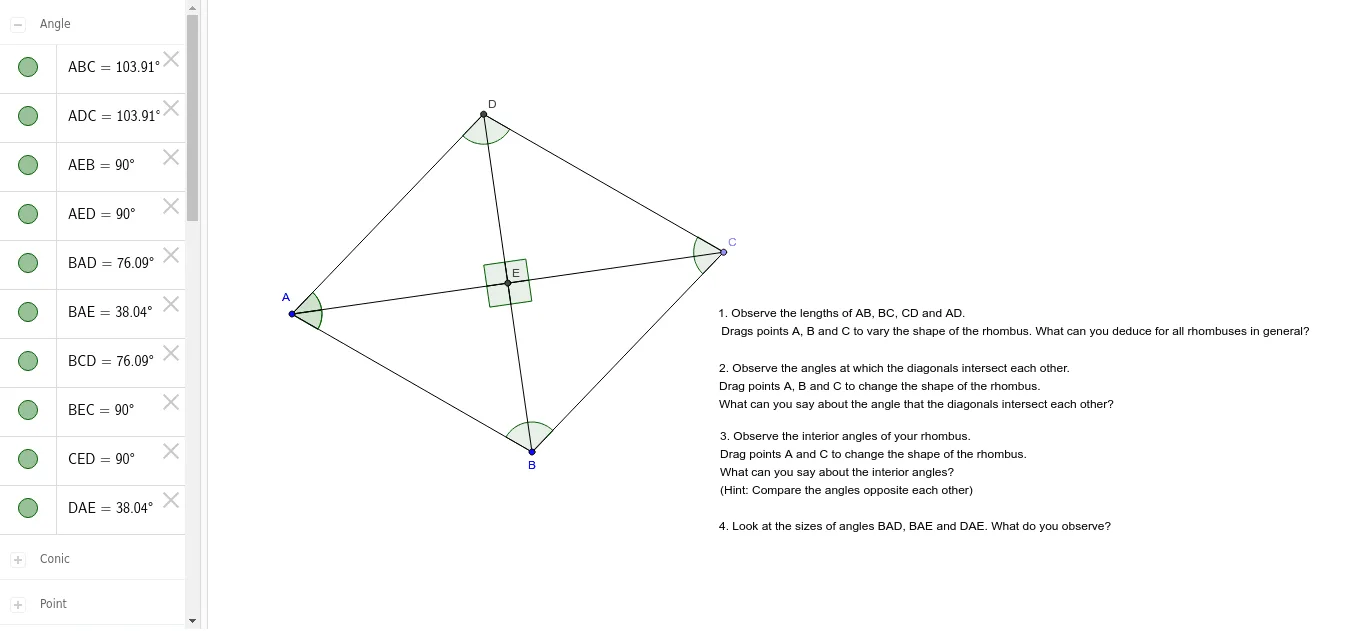
This example demonstrates the properties of a rhombus. Key mathematical concepts include the definition of a rhombus, properties of diagonals, and area calculation. It is constructed using GeoGebra commands such as Circle, Point, Intersect, etc. Suitable for middle school and above students to learn geometric construction.
GeoGebra Commands & Parameters
Circle(A, B) → c_1Circle(B, A) → d_1Point(d_1) → CCircle(C, B) → e_1Intersect(c_1, e_1, 2) → DSegment(A, D) → ADSegment(D, C) → CDSegment(B, C) → BCSegment(A, B) → ABSegment(A, C) → ACSegment(B, D) → BDIntersect(AC, BD) → EAngle(D, E, C) → CEDAngle(D, E, A) → AEDAngle(A, E, B) → AEBAngle(B, E, C) → BECAngle(A, D, C) → ADCAngle(D, A, B) → BADAngle(A, B, C) → ABCAngle(B, C, D) → BCDAngle(B, A, E) → BAEAngle(D, A, E) → DAE
AI Drawing Prompt Reference
Draw a rhombus. The rhombus consists of four points A, B, C, and D, where A and B are adjacent vertices, B and C are adjacent, C and D are adjacent, and D and A are adjacent. The diagonals AC and BD intersect at point E. The four angles of the rhombus are angle ABC, angle BCD, angle CDA, and angle DAB. The diagonals divide the rhombus into four congruent triangles. The construction order is to draw points A and B first, then points C and D, then draw diagonals AC and BD, and finally mark the intersection point E.
The prompt above was compiled from the original drawing commands and is for reference only.