
Properties of a Rhombus by saksu
Loading the math board and drawing, please wait…
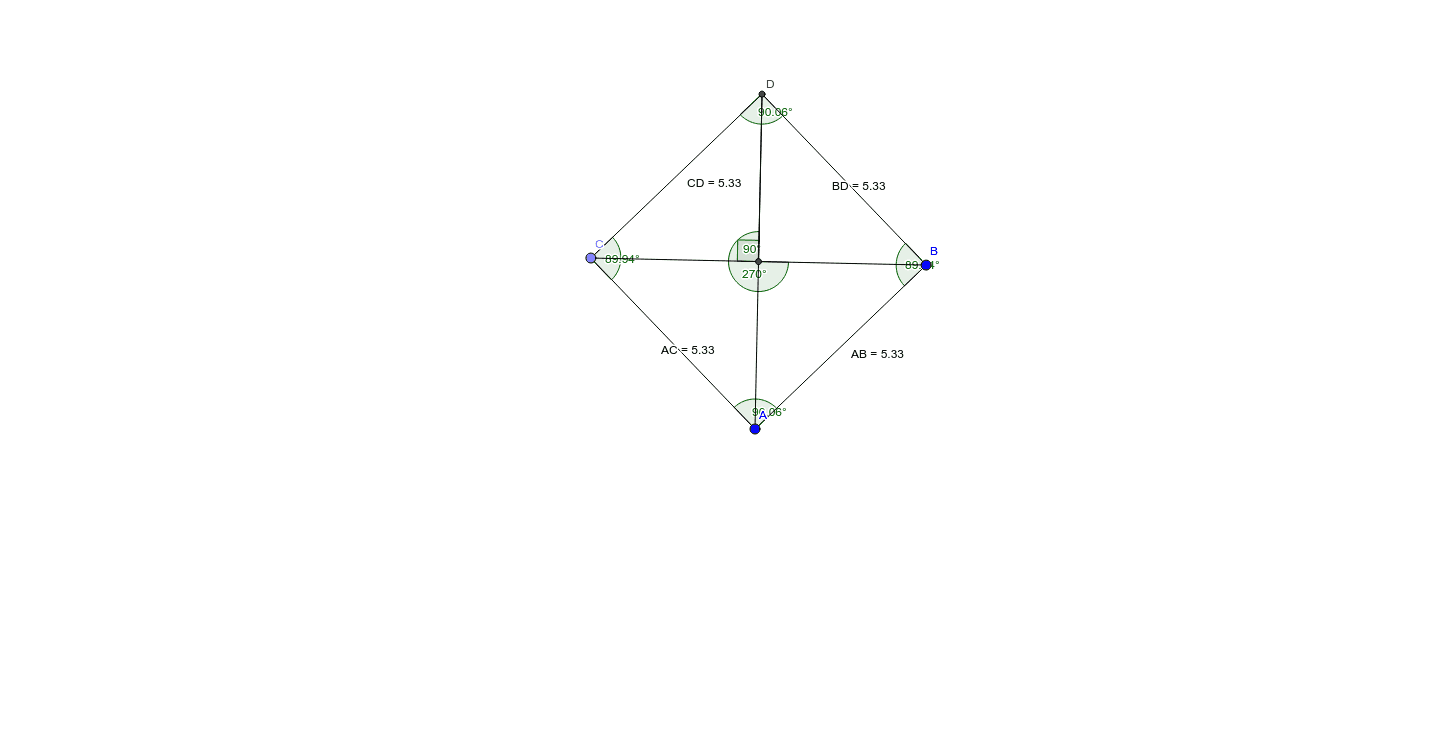
①This example dynamically demonstrates the definition and core properties of a rhombus, showing that all four sides are equal, diagonals are perpendicular bisectors of each other, and diagonals bisect the angles. ②Key mathematical concepts include rhombus, parallelogram, diagonals, perpendicular bisector, angle bisector, symmetry, and perimeter. ③Construction: Using GeoGebra commands Circle, Point, Segment, Line, Intersect, and Angle, the rhombus ABCD with diagonals AC and BD is constructed, with angles α, β, γ, δ and intersection point E labeled; measurements verify the properties. ④Suitable for middle school geometry lessons or self-study, helping students understand the special properties of a rhombus compared to a general parallelogram, and serving as a starting point for dynamic exploration.
GeoGebra Commands & Parameters
Circle(A, B) → cPoint(c) → CSegment(C, A) → ACSegment(A, B) → ABLine(B, AC) → aLine(C, AB) → bIntersect(a, b) → DSegment(C, D) → CDSegment(D, B) → BDAngle(C, D, B) → αAngle(B, A, C) → βAngle(A, C, D) → γAngle(D, B, A) → δSegment(D, A) → dSegment(C, B) → eIntersect(e, d) → ESegment(E, D) → fAngle(D, E, B) → εAngle(D, E, C) → ζ
AI Drawing Prompt Reference
Draw a rhombus to demonstrate that all four sides are equal, the diagonals are perpendicular bisectors of each other, and the diagonals bisect the angles. Start by drawing two intersecting circles, find the intersection points and points on the circles, connect them to form the rhombus, label the diagonals, intersection point, and angles, then use measurements to verify the properties.
The prompt above was compiled from the original drawing commands and is for reference only.