
Properties of a Parallelogram by kjmillikan
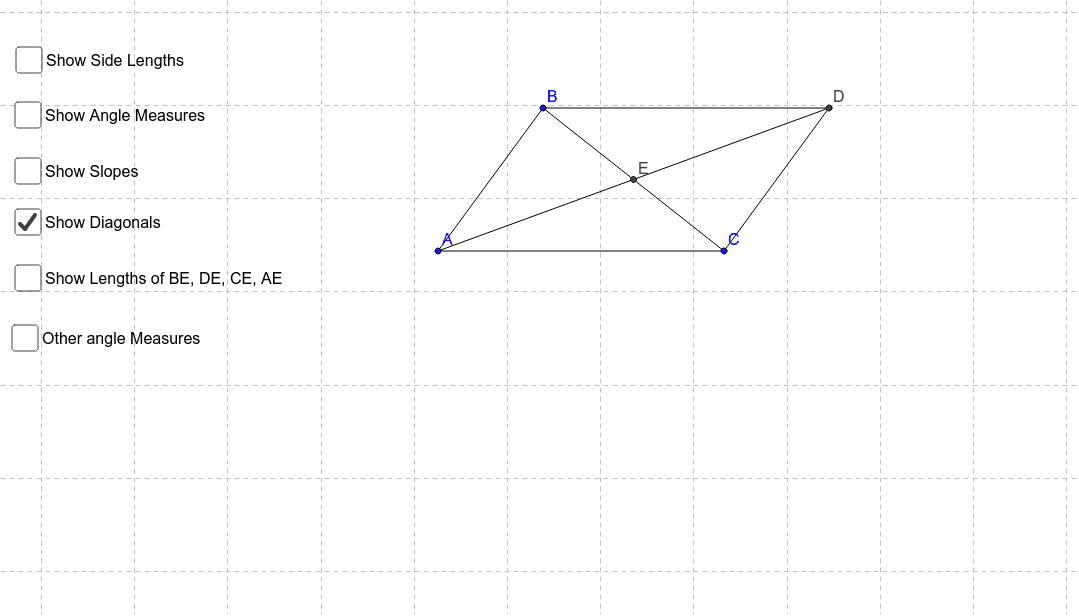
Loading the math board and drawing, please wait…
This example demonstrates the geometric properties of a parallelogram, including parallel opposite sides, equal opposite angles, equal opposite sides, and bisecting diagonals. It involves core mathematical concepts such as properties of parallel lines, congruent triangles, similarity transformations, vector operations, and coordinate geometry. The construction uses GeoGebra commands and objects like Line, Segment, Intersect, Angle, Distance, and Slope to create vertices A, B, C, D, sides a, b, c, d, diagonals AC and BD, midpoints E, heights h, etc. It is suitable for high school students and teachers to explore dynamic properties of parallelograms.
GeoGebra Commands & Parameters
Line(A, B) → aLine(C, a) → bSegment(A, C) → cLine(B, c) → dIntersect(b, d) → DSegment(B, D) → eSegment(A, B) → fSegment(C, D) → gAngle(A, B, D) → αAngle(D, C, A) → βAngle(C, A, B) → γAngle(B, D, C) → δDistance(B, D) → distanceBDDistance(A, B) → distanceABDistance(A, C) → distanceACDistance(D, C) → distanceDCSlope(e) → mSlope(g) → m_1Slope(c) → m_2Slope(f) → m_3Segment(A, D) → kSegment(B, C) → lIntersect(l, k) → EDistance(B, E) → distanceBEDistance(C, E) → distanceCEDistance(A, E) → distanceAEDistance(D, E) → distanceDEDistance(B, C) → distanceBCDistance(A, D) → distanceADAngle(C, A, D) → εAngle(D, A, B) → ζAngle(B, D, A) → ηAngle(A, D, C) → θAngle(B, C, A) → ιAngle(D, C, B) → κAngle(C, B, D) → λAngle(A, B, C) → μAngle(A, E, C) → νAngle(C, E, D) → ξAngle(D, E, B) → οAngle(B, E, A) → ρ