
Isosceles Trapezoid Properties Demo by kjmillikan
Loading the math board and drawing, please wait…
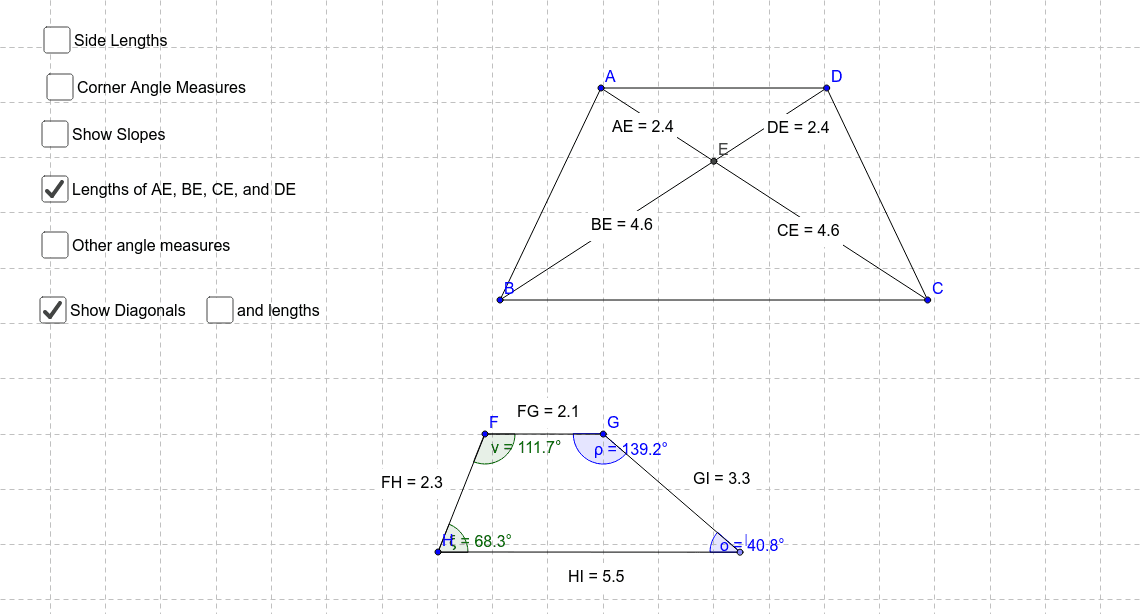
This example demonstrates the geometric properties of an isosceles trapezoid, including parallel opposite sides, equal non-parallel sides, and congruent diagonals. Key math concepts involved are parallel lines, isosceles triangles, diagonals, angles, distances, and slopes. The construction utilizes GeoGebra commands such as Segment, Mirror, Angle, Intersect, Distance, Slope, Line, and Point to build the figure and calculate related attributes. It is suitable for high school mathematics instruction, providing an intuitive visualization of trapezoid properties and calculation methods.
GeoGebra Commands & Parameters
Segment(A, B) → aSegment(C_1, D_1) → bMirror(A, b) → DMirror(B, b) → CSegment(D, C) → a'Segment(A, D) → cSegment(B, C) → dAngle(C, B, A) → αAngle(D, C, B) → βAngle(B, A, D) → γAngle(A, D, C) → δSegment(A, C) → eSegment(D, B) → fIntersect(f, e) → EDistance(A, D) → distanceADDistance(A, B) → distanceABDistance(B, C) → distanceBCDistance(C, D) → distanceCDDistance(A, E) → distanceAEDistance(D, E) → distanceDEDistance(B, E) → distanceBEDistance(C, E) → distanceCEDistance(A, C) → distanceACDistance(D, B) → distanceDBAngle(C, A, D) → εAngle(A, D, B) → ζAngle(C, B, D) → ηAngle(A, C, B) → θAngle(D, E, A) → ιAngle(B, E, C) → κAngle(A, E, B) → λAngle(C, E, D) → μSlope(c) → mSlope(d) → m_1Slope(a) → m_2Slope(a') → m_3Segment(F, G) → pLine(H, p) → qPoint(q) → ISegment(H, I) → rSegment(I, G) → sSegment(F, H) → tDistance(G, I) → distanceGIDistance(F, G) → distanceFGDistance(F, H) → distanceFHDistance(H, I) → distanceHIAngle(H, F, G) → νAngle(I, H, F) → ξAngle(G, I, H) → οAngle(F, G, I) → ρ
AI Drawing Prompt Reference
Draw an isosceles trapezoid, highlighting its parallel opposite sides, equal non-parallel sides, and congruent diagonals. Label the lengths of sides, angles, and diagonals, and calculate distances between key points. Start by drawing the base and top, use reflection to construct the equal sides, then connect them to form the trapezoid. Label the diagonals to prove congruence, calculate the sizes of angles, and display the lengths, angles, and slopes of the sides and diagonals.
The prompt above was compiled from the original drawing commands and is for reference only.