
Proofs about Parallelograms
Loading the math board and drawing, please wait…
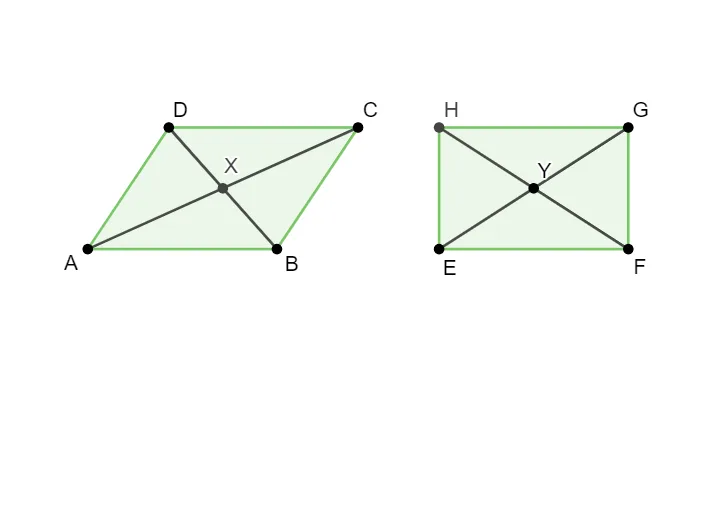
This example demonstrates proofs about parallelograms. Key mathematical concepts include properties and proof methods of parallelograms. Using GeoGebra commands such as Segment, Line, Intersect, and Polygon, the geometric characteristics of parallelograms can be constructed and explored. Suitable for middle school and above students or teachers.
GeoGebra Commands & Parameters
Segment(A, B) → fSegment(B, C) → gLine(C, f) → hLine(A, g) → iIntersect(h, i) → DPolygon(A, B, C, D) → q1, a, b, c, dSegment(E, F) → jSegment(D, B) → n_1Segment(A, C) → pIntersect(n_1, p) → XLine(B, C) → i'Line(A, B) → h'Line(E, F) → l'OrthogonalLine(F, l') → kPoint(k) → GLine(G, l') → lLine(E, k) → mIntersect(l, m) → HPolygon(E, F, G, H) → q2, e, f_1, g_1, h_1Segment(E, G) → nSegment(F, H) → qIntersect(n, q) → Y
AI Drawing Prompt Reference
Draw a parallelogram by first sketching two adjacent sides, then creating parallel lines through these sides. The intersection of these parallel lines with the sides forms the parallelogram. Next, draw a diagonal inside the parallelogram and find its intersection with the other side. Then, draw two line segments parallel to the sides of the parallelogram and locate their intersection, forming another small parallelogram. Finally, connect the diagonals of both parallelograms and find their intersection point.
The prompt above was compiled from the original drawing commands and is for reference only.