
Proof Without Words by Steve Phelps (9)
Loading the math board and drawing, please wait…
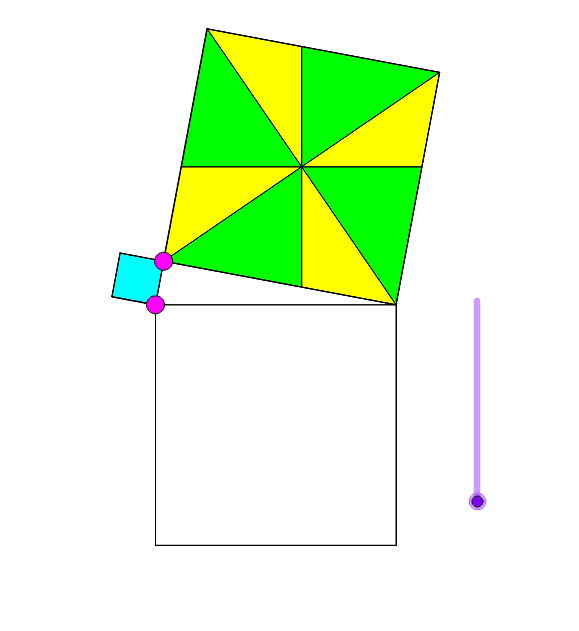
This example demonstrates the Pythagorean Theorem through geometric manipulation by dragging points and a slider. It involves core concepts like the Pythagorean Theorem, difference and slope, ellipses, subtraction, and congruence. The construction utilizes GeoGebra commands such as Point, Intersect, CircleArc, Polygon, Segment, OrthogonalLine, If, Dilate, Vector, and Translate. It is suitable for high school mathematics education to visually understand geometric proofs and dynamically demonstrate mathematical concepts.
GeoGebra Commands & Parameters
Point(xAxis) → AIntersect(xAxis, yAxis) → BCircleArc(B, D, A) → cPoint(c) → EPolygon(A, E, 4) → poly1, a, b, d, e, F, GPolygon(E, C, 4) → poly2, f, g, h, i, H, IPolygon(C, A, 4) → poly3, j, k, l, m, J, KSegment(E, H) → nSegment(I, C) → pIntersect(n, p) → LOrthogonalLine(L, j) → qOrthogonalLine(L, q) → rIntersect(r, i) → MIntersect(q, h) → NIntersect(r, g) → OIntersect(q, f) → PPolygon(M, L, E) → poly4, e_1, m_1, l_1Polygon(M, I, L) → poly5, l_2, m_2, i_1Polygon(L, N, I) → poly6, i_2, l_3, n_1Polygon(L, H, N) → poly7, n_2, l_4, h_1Polygon(L, O, H) → poly8, h_2, l_5, oPolygon(L, C, O) → poly9, o_1, l_6, c_1Polygon(L, P, C) → poly10, c_2, l_7, p_1Polygon(L, P, E) → poly11, e_2, l_8, p_2Polygon(F, G, A, E) → poly12, f_1, g_1, a_1, e_3If(0 ≤ t ≤ 1, 1 - t, If[t > 1, 0, 1]) → d1Dilate(L, d1, A) → L'Dilate(L, d1, C) → L'_1Dilate(L, d1, K) → L'_2Dilate(L, d1, J) → L'_3Vector(L, L') → uVector(L, L'_3) → vVector(L, L'_2) → wVector(L, L'_1) → sTranslate(L, u) → L'_4Translate(P, u) → P'Translate(C, u) → C'Polygon(L'_4, P', C') → poly10', c', l'_4, p'Translate(L, v) → L'_5Translate(O, v) → O'Translate(H, v) → H'Polygon(L'_5, O', H') → poly8', h', l'_5, o'Translate(L, w) → L'_6Translate(N, w) → N'Translate(I, w) → I'Polygon(L'_6, N', I') → poly6', i', l'_6, n'Translate(M, s) → M'Translate(L, s) → L'_7Translate(E, s) → E'Polygon(M', L'_7, E') → poly4', e', m', l'_7If(1 ≤ t ≤ 2, 2 - t, If[t > 2, 0, 1]) → d2Dilate(L, d2, A) → L'_8Dilate(L, d2, J) → L'_9Dilate(L, d2, K) → L'_{10}Dilate(L, d2, C) → L'_{11}Vector(L, L'_8) → u_1Vector(L, L'_9) → v_1Vector(L, L'_{10}) → w_1Vector(L, L'_{11}) → b_1Translate(L, v_1) → L'_{12}Translate(H, v_1) → H'_1Translate(N, v_1) → N'_1Polygon(L'_{12}, H'_1, N'_1) → poly7', n'_1, l'_{12}, h'_1Translate(L, u_1) → L'_{13}Translate(C, u_1) → C'_1Translate(O, u_1) → O'_1Polygon(L'_{13}, C'_1, O'_1) → poly9', o'_1, l'_{13}, c'_1Translate(M, w_1) → M'_1Translate(I, w_1) → I'_1Translate(L, w_1) → L'_{14}Polygon(M'_1, I'_1, L'_{14}) → poly5', l'_{14}, m'_1, i'_1Translate(L, b_1) → L'_{15}Translate(P, b_1) → P'_1Translate(E, b_1) → E'_1Polygon(L'_{15}, P'_1, E'_1) → poly11', e'_1, l'_{15}, p'_1If(2 ≤ t ≤ 3, 3 - t, If[t > 3, 0, 1]) → d3Dilate(F, d3, E') → F'Vector(F, F') → d_1Translate(F, d_1) → F'_1Translate(G, d_1) → G'Translate(A, d_1) → A'Translate(E, d_1) → E'_2Polygon(F'_1, G', A', E'_2) → poly12', f'_1, g', a', e'_2
AI Drawing Prompt Reference
Draw a right triangle ABC with point A on the x-axis, point B at the origin, and point C on the y-axis. Construct several polygons using points E, F, G, H, I, and J, adjust the shape with slider t, and use point L to create a series of perpendicular lines and polygons, ultimately forming a series of similar polygons to demonstrate the geometric proof of the Pythagorean theorem.
The prompt above was compiled from the original drawing commands and is for reference only.