
Proof without Words: Arithmetic Sequences
Loading the math board and drawing, please wait…
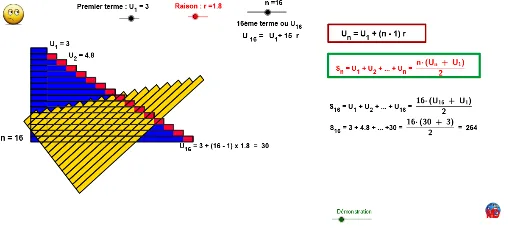
This example visually demonstrates the properties of arithmetic sequences. Key mathematical concepts include the definition of arithmetic sequences, their summation formula, and the geometric construction of arithmetic sequences. Commands used include Sequence, Rotate, and Polygon. Suitable for high school math education, aiding students in intuitively understanding the summation formula of arithmetic sequences.
GeoGebra Commands & Parameters
Sequence(Polygon[A + (0, (-i) + 1), A + (0, (-i)), A + (U_1 + ((i - 1) * r), (-i)), A + (U_1 + ((i - 1) * r), (-i) + 1)], i, 1, n) → liste1Rotate(A, Somme, M) → A'Rotate(C, Somme, M) → C'Rotate(D, Somme, M) → D'Sequence(Polygon[A' + ((i - 1) * (C' - A')), A' + (i * (C' - A')), A' + (i * (C' - A')) + ((U_1 + ((i - 1) * r)) * (D' - C')), A' + ((i - 1) * (C' - A')) + ((U_1 + ((i - 1) * r)) * (D' - C'))], i, 1, n) → liste2Sequence(Polygon[A + (0, (-i) + 1), A + (0, (-i)), A + (U_1 + ((i - 1) * r), (-i)), A + (U_1 + ((i - 1) * r), (-i) + 1)], i, 1, n) → liste3Sequence(Polygon[A' + ((i - 1) * (C' - A')), A' + (i * (C' - A')), A' + (i * (C' - A')) + ((U_1 + ((i - 1) * r)) * (D' - C')), A' + ((i - 1) * (C' - A')) + ((U_1 + ((i - 1) * r)) * (D' - C'))], i, 1, n) → liste4Polygon(I, J, K, L) → poly1, i, j, k, lPolygon(N, O, P, Q) → poly2, n_1, o, p, qSequence(Polygon[A + (U_1 + ((i - 1) * r) - r, (-i) + 1), A + (U_1 + ((i - 1) * r) - r, (-i)), A + (U_1 + ((i - 1) * r), (-i)), A + (U_1 + ((i - 1) * r), (-i) + 1)], i, 2, n) → liste5Sequence(Polygon[A + (U_1, (-i) + 1), A + (U_1, (-i)), A + (U_1 + ((i - 1) * r), (-i)), A + (U_1 + ((i - 1) * r), (-i) + 1)], i, 2, n) → liste6Sequence(R + (0, (-i)), i, 0, n) → liste7
AI Drawing Prompt Reference
Draw a diagram with two rows of rectangles illustrating arithmetic sequence summation. The bottom row has n adjacent rectangles with heights increasing from left to right according to an arithmetic sequence. The top row is formed by rotating the bottom row 180 degrees and placing it above, creating a complementary staircase. Together they form a large parallelogram or rectangle, visually demonstrating the sum formula. All rectangles are tightly packed without gaps, giving a symmetric geometric appearance.
The prompt above was compiled from the original drawing commands and is for reference only.