
Proof of the Law of Sines by Albert Navetta
Loading the math board and drawing, please wait…
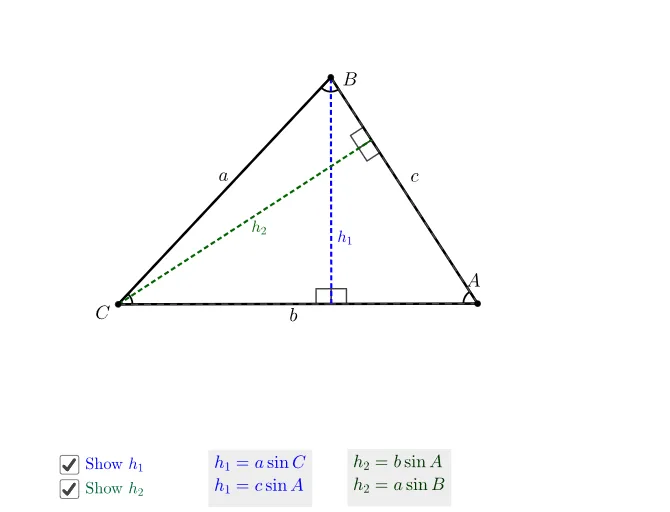
This example demonstrates the proof of the Law of Sines, which relates the lengths of the sides of a triangle to the sines of its angles. By constructing the altitudes of the triangle and using the properties of similar triangles, the proof is derived. The example uses commands such as Polygon, PointIn, Angle, OrthogonalLine, Line, Intersect, Segment, and Corner in GeoGebra, suitable for high school mathematics education.
GeoGebra Commands & Parameters
Polygon((-9.08831568900743, 1.4996534836992197), (110.91168431099257, 1.4996534836992197), (110.91168431099257, 81.49965348369926), (-9.08831568900743, 81.49965348369926)) → tv, j, k, l, mPointIn(tv) → BPointIn(tv) → CPointIn(tv) → APolygon(A, B, C) → poly1, c, a, bAngle(C, B, A) → angBAngle(A, C, B) → angCAngle(B, A, C) → angAOrthogonalLine(B, b) → dLine(A, C) → eIntersect(d, e) → Base1Segment(Base1, B) → h1Segment(C, Base1) → ext1Segment(A, Base1) → ext2Angle(B, Base1, C) → h1ang1Angle(A, Base1, B) → h1ang2Line(A, B) → fOrthogonalLine(C, f) → gIntersect(f, g) → Base2Segment(B, Base2) → ext3Segment(C, Base2) → h2Angle(C, Base2, A) → h2ang1Segment(A, Base2) → ext4Angle(B, Base2, C) → h2ang2Polygon(Base1, B, C) → trih11, c_1, base1, b_1Polygon(Base1, A, B) → trih12, b_2, h, a_1Polygon(A, Base2, C) → trih21, c_2, a_2, base2Polygon(Base2, B, C) → trih22, c_3, i, b_3Corner(5) → Thedims
AI Drawing Prompt Reference
Draw a triangle and erect perpendiculars from each vertex to the opposite sides, forming three right-angled triangles. Measure the lengths of the opposite sides and hypotenuses of these triangles, and label the angles of the main triangle. Use the properties of similar triangles to demonstrate the proportional relationship between the sides of the large triangle and the sines of its corresponding angles, proving the Law of Sines.
The prompt above was compiled from the original drawing commands and is for reference only.