
Proof of Pythagorean Theorem
Loading the math board and drawing, please wait…
In collections
Pythagorean Theorem
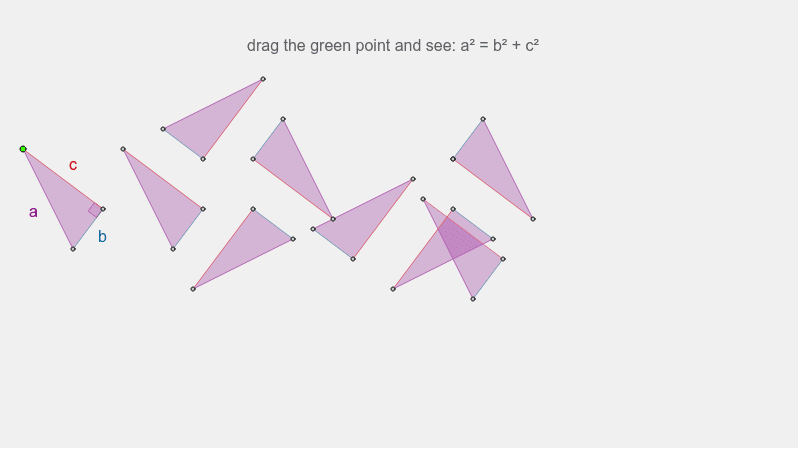
This example demonstrates a geometric proof of the Pythagorean Theorem. The core math concepts involved are the relationship among the sides of a right triangle, expressed as a²+b²=c². The construction utilizes GeoGebra commands such as Segment, Point, Semicircle, Polygon, Vector, Rotate, Translate, OrthogonalLine, Intersect, and Angle. It is suitable for high school mathematics teaching or self-study to help understand the visual proof of the theorem.
GeoGebra Commands & Parameters
Segment(F_1, G_1) → ePoint(e) → BSemicircle(B, A) → c_1Point(c_1) → CPolygon(A, C, B) → poly1, b, c, αVector(D, V) → uRotate(A, 90*°, C) → A'Rotate(C, 90*°, C) → C'Rotate(B, 90*°, C) → B'Polygon(A', C', B') → poly1', b', a', c'Translate(A, u) → A'_1Translate(C, u) → C'_1Translate(B, u) → B'_1Polygon(A'_1, C'_1, B'_1) → poly1'_1, b'_1, a'_1, c'_1Vector(W, Z) → vTranslate(A', v) → A''Translate(C', v) → C''Translate(B', v) → B''Polygon(A'', C'', B'') → poly1'', b'', a'', c''Vector(A_1, B_1) → wRotate(A, 270*°, C) → A'_2Rotate(C, 270*°, C) → C'_2Rotate(B, 270*°, C) → B'_2Polygon(A'_2, C'_2, B'_2) → poly1'_2, b'_2, a'_2, c'_2Translate(A'_2, w) → C_1Translate(C'_2, w) → D_1Translate(B'_2, w) → E_1Polygon(C_1, D_1, E_1) → poly2, e_1, c_3, d_2Rotate(A, 180*°, C) → A'_3Rotate(C, 180*°, C) → C'_3Rotate(B, 180*°, C) → B'_3Polygon(A'_3, C'_3, B'_3) → poly1'_3, b'_3, a'_3, c'_3Vector(E, F) → zTranslate(A'_3, z) → GTranslate(C'_3, z) → HTranslate(B'_3, z) → IPolygon(G, H, I) → poly3, i, g, hPolygon(D_1, H, C'', C'_1) → poly4, d_3, h_1, c''_1, c'_4Vector(J_1, K_1) → fVector(O_1, P_1) → jSegment(F_1, B) → dVector(J, K) → kTranslate(D_1, k) → LTranslate(H, k) → H'Translate(C'', k) → C'''Translate(C'_1, k) → MPolygon(L, H', C''', M) → poly4', l, h', c''', mTranslate(A'', k) → A'''Translate(C'', k) → C'''_1Translate(B'', k) → B'''Polygon(A''', C'''_1, B''') → poly1''', b''', a''', c'''_1Translate(D_1, k) → OTranslate(E_1, k) → PTranslate(A'_1, f) → QTranslate(C'_1, f) → RTranslate(B'_1, f) → SPolygon(Q, R, S) → poly5, s, q, rTranslate(G, k) → G'Translate(H, k) → H'_1Translate(I, k) → I'Polygon(G', H'_1, I') → poly3', i', g', h'_1Translate(C_1, j) → TTranslate(D_1, j) → UTranslate(E_1, j) → H_1Polygon(T, U, H_1) → poly2'_1, h_2, t, u_1Polygon(Q_1, L_1, N_1, R_1) → poly6, q_1, l_1, n_1, r_1Polygon(I_1, M_1, S_1, N_1) → poly7, i_1, m_1, s_1, n_2OrthogonalLine(L, t) → aIntersect(t, a) → NSegment(L, N) → b_1Intersect(b_1, a''') → T_1Segment(T_1, N) → nAngle(B, C, A) → β
AI Drawing Prompt Reference
Draw a right triangle ABC with AB as the hypotenuse, then construct a semicircle with C as the center and AC as the radius. Next, construct a square that is tangent to the semicircle. Use translation and rotation operations to construct multiple similar figures to the original triangle, and use these figures to prove the Pythagorean theorem.
The prompt above was compiled from the original drawing commands and is for reference only.