
Proof for Area of a Parallelogram: Using Similar Triangles and Geometric Constru
Loading the math board and drawing, please wait…
In collections
Area of Polygons
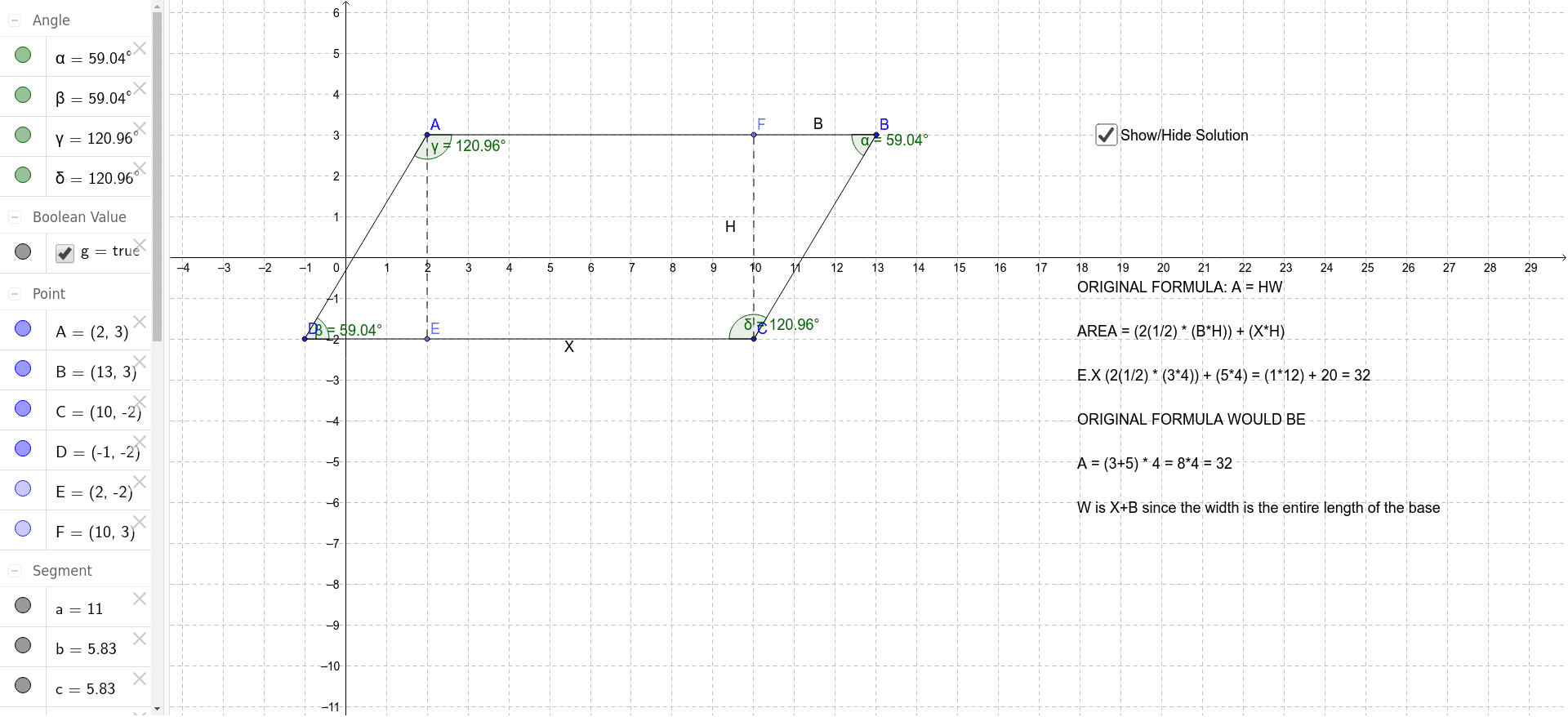
This example demonstrates how to prove the area of a parallelogram using similar triangles and geometric construction. Key mathematical concepts include similarity, area calculation, and geometric construction. The construction involves GeoGebra commands such as Segment, Angle, Point to create the parallelogram. Suitable for middle or high school mathematics to understand area formulas and geometric principles.
GeoGebra Commands & Parameters
Segment(A, B) → aSegment(B, C) → bSegment(A, D) → cSegment(D, C) → dAngle(A, B, C) → αAngle(C, D, A) → βAngle(D, A, B) → γAngle(B, C, D) → δPoint(d) → ESegment(A, E) → ePoint(a) → FSegment(C, F) → f
AI Drawing Prompt Reference
Draw a parallelogram ABCD and connect the diagonals AC. Take points E on AB and F on CD such that AE is parallel to CF. Construct angles α, β, γ, and δ to prove the area formula of the parallelogram, where α and γ are the angles at the base, and β and δ are the vertex angles.
The prompt above was compiled from the original drawing commands and is for reference only.