
Proof: Cosine Rule 2
Loading the math board and drawing, please wait…
In collections
Proof of Sine Rule, Cosine Rule, Area of a Triangle
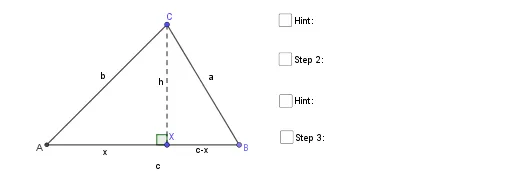
This GeoGebra example demonstrates a second geometric proof of the cosine rule (law of cosines), visually showing how the square of one side of a triangle relates to the other two sides and the cosine of the included angle. The core mathematical concept is the cosine rule, which generalizes the Pythagorean theorem to any triangle, involving trigonometric functions (cosine) and algebraic manipulation. The construction uses GeoGebra commands such as Intersect, Point, Segment, Polygon, and Angle to create triangle ABC with sides a, b, c, and adds auxiliary elements like the altitude h, foot X, and text labels to illustrate the proof step by step. Suitable for high school students learning trigonometry and solving triangles, as well as for teachers demonstrating the proof in class or for self-study, helping learners grasp the geometric essence and logical derivation of the cosine rule.
GeoGebra Commands & Parameters
Intersect(xAxis, yAxis) → APoint(xAxis) → BSegment(C, A) → bSegment(A, B) → cSegment(B, C) → aSegment(C, X) → hPolygon(C, A, X) → t1, x_1, c_1, a_1Polygon(C, X, B) → t2, b_1, c_2, x_2Angle(C, X, A) → α
AI Drawing Prompt Reference
Draw a triangle with labeled sides and angles. From one vertex, draw a perpendicular line to the opposite side, marking the foot of the altitude. Shade the three smaller triangles formed inside the main triangle with different colors or patterns, labeling the sides and angles of each smaller triangle. Finally, add text annotations to demonstrate the proof of the cosine rule, showing that the square of one side equals the sum of the squares of the other two sides minus twice their product times the cosine of the included angle.
The prompt above was compiled from the original drawing commands and is for reference only.