
Geometric Proof of the Pythagorean Theorem (Euclid's Elements)
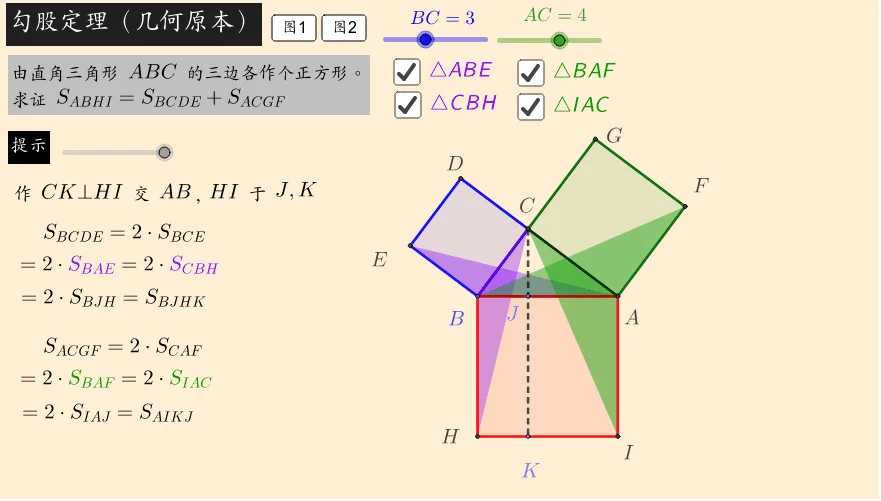
This interactive GeoGebra applet presents a dynamic and rigorous visualization of the classic geometric proof of the Pythagorean theorem, directly inspired by Proposition I.47 of Euclid's Elements. Often referred to as the Windmill proof due to the distinctive shape of its geometric construction, this demonstration moves beyond simple algebraic formulas to reveal the profound geometric essence of the theorem. The applet constructs a right triangle alongside three squares, each built upon one of the triangle's sides. The core mathematical concept relies on polygon area decomposition and the properties of congruent triangles. By drawing specific auxiliary lines, the applet partitions the squares on the two legs into smaller polygons. It then visually maps these partitioned regions to corresponding sections within the square constructed on the hypotenuse. Through this process of geometric dissection and area equivalence, users can clearly observe that the combined area of the two smaller squares is exactly equal to the area of the largest square. Designed for active exploration, the applet allows users to interact with the geometric figures in real time. Students and educators can drag the vertices of the right triangle to alter its side lengths and angles, instantly updating the dimensions of the attached squares. Despite these continuous transformations, the fundamental area relationship remains invariant. The interface includes step-by-step toggles or sliders that guide the user through the logical progression of Euclid's proof, highlighting specific congruent triangles and equal-area regions at each stage of the deduction. This tool is an invaluable asset for geometry education. It bridges the gap between abstract algebraic equations and concrete spatial reasoning. By watching the areas dynamically rearrange and match, students develop a deep, intuitive understanding of why the Pythagorean theorem holds true geometrically, rather than just memorizing the standard formula. Furthermore, it introduces learners to the rigorous logic and axiomatic structure of classical mathematics, fostering critical thinking and a deeper appreciation for formal mathematical proof. It is highly suitable for middle school and high school geometry classrooms, as well as for independent study by anyone interested in the foundational principles of Euclidean geometry.
In collections
My First GeoGebra Interactive Book
My First Picture Book - GeoGebra Collection
My First GeoGebra Book
My First Picture Book: GeoGebra Collection
Loading the math board and drawing, please wait…