
Pythagorean Theorem: Projection Proof Without Words
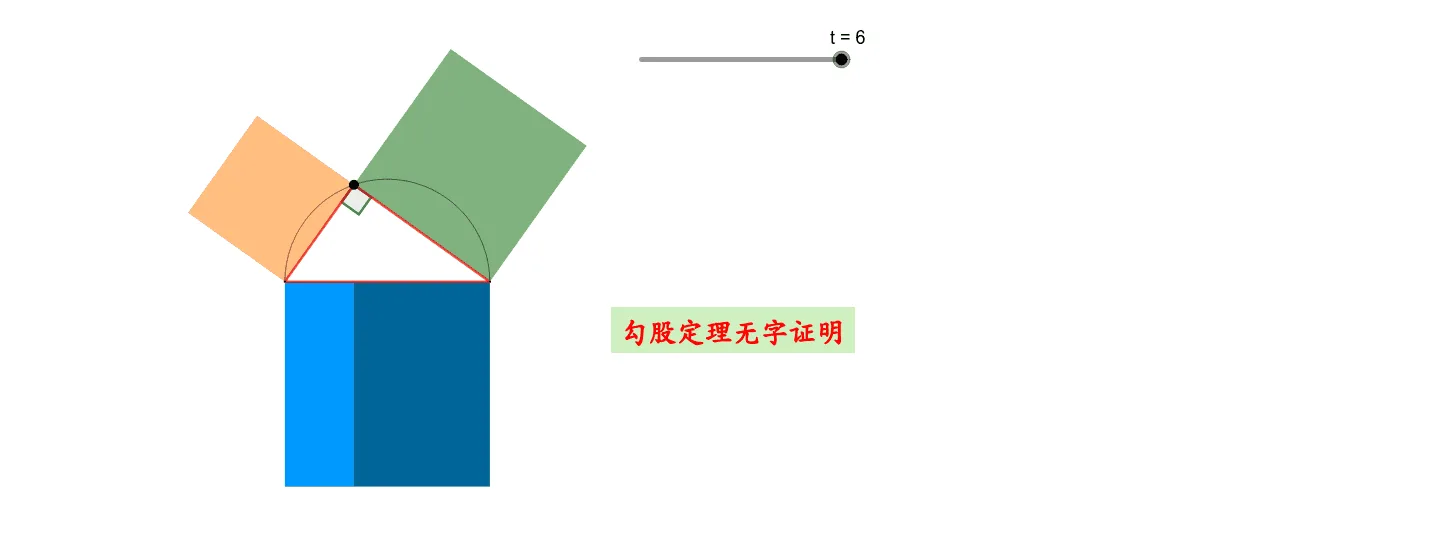
This GeoGebra applet demonstrates a proof without words of the Pythagorean theorem using projection methods. By constructing semicircles, polygons, orthogonal lines, and intersections, it visually and dynamically illustrates the geometric essence of the relationship between the squares of the sides of a right triangle. The construction is intuitive and rigorous, making it suitable for teaching geometry at the secondary and university levels. Students can interact with the applet to manipulate the right triangle and observe how the areas of the squares constructed on each side relate through projection. The dynamic visualization allows learners to see how dropping perpendiculars from the right angle vertex to the hypotenuse divides the triangle into two smaller similar triangles, each projecting onto the squares built on the adjacent legs. This geometric decomposition directly reveals why a squared plus b squared equals c squared, without relying on algebraic manipulation alone. The no-words approach encourages students to discover the logical chain of reasoning themselves, fostering deeper conceptual understanding rather than rote memorization. The semicircle constructions reinforce the connection between right triangles and Thales' theorem, while the polygon and intersection tools highlight how projective relationships preserve area ratios. Educators can use this applet as a classroom demonstration or assign it as an exploratory activity for independent study. The interactive sliders let students adjust the triangle's dimensions and verify that the proof holds universally, not just for special cases. This applet bridges the gap between visual intuition and formal geometric proof, making it an invaluable resource for instructors seeking to enrich their geometry curriculum with dynamic, technology-enhanced learning experiences.
Loading the math board and drawing, please wait…