
Projectile Motion by Filip Bar
Loading the math board and drawing, please wait…
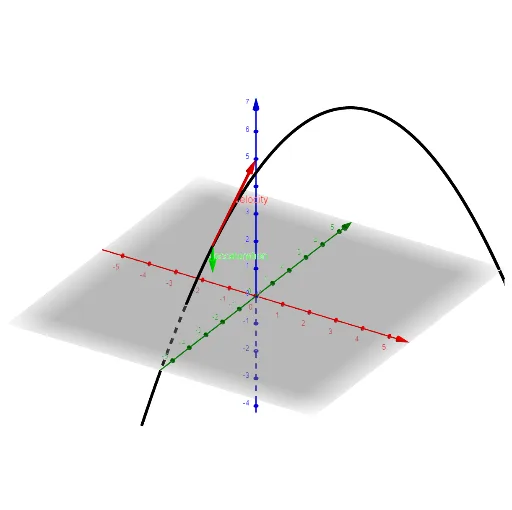
This example demonstrates the trajectory and force analysis of projectile motion. It involves core mathematical concepts such as vectors, three-dimensional space, derivatives and integrals in differential calculus, parabolas, quadratic equations, similarity transformations, translation, and exponential functions. The construction uses the 'CurveCartesian' command to plot the trajectory and 'Vector' objects to represent velocity, acceleration, and displacement vectors. It is suitable for high school and above students to learn and understand the principles of projectile motion in physics, as well as for visualizing calculus and linear algebra concepts.
GeoGebra Commands & Parameters
CurveCartesian((s_x, s_{y}, s_{z}) + ((v_{x}, v_{y}, v_{z}) * t) + ((1 / 2 * (a_{x}, a_{y}, a_{z})) * t^(2)), t, -10, 10) → γVector((s_x, s_{y}, s_{z}) + ((v_{x}, v_{y}, v_{z}) * t) + ((1 / 2 * (a_{x}, a_{y}, a_{z})) * t^(2)), (s_x, s_{y}, s_{z}) + ((v_{x}, v_{y}, v_{z}) * t) + ((1 / 2 * (a_{x}, a_{y}, a_{z})) * t^(2)) + (v_{x}, v_{y}, v_{z}) + ((a_{x}, a_{y}, a_{z}) * t)) → vVector((s_x, s_{y}, s_{z}) + ((v_{x}, v_{y}, v_{z}) * t) + ((1 / 2 * (a_{x}, a_{y}, a_{z})) * t^(2)), (s_x, s_{y}, s_{z}) + ((v_{x}, v_{y}, v_{z}) * t) + ((1 / 2 * (a_{x}, a_{y}, a_{z})) * t^(2)) + (a_{x}, a_{y}, a_{z})) → a