
Helix and Derivatives
Loading the math board and drawing, please wait…
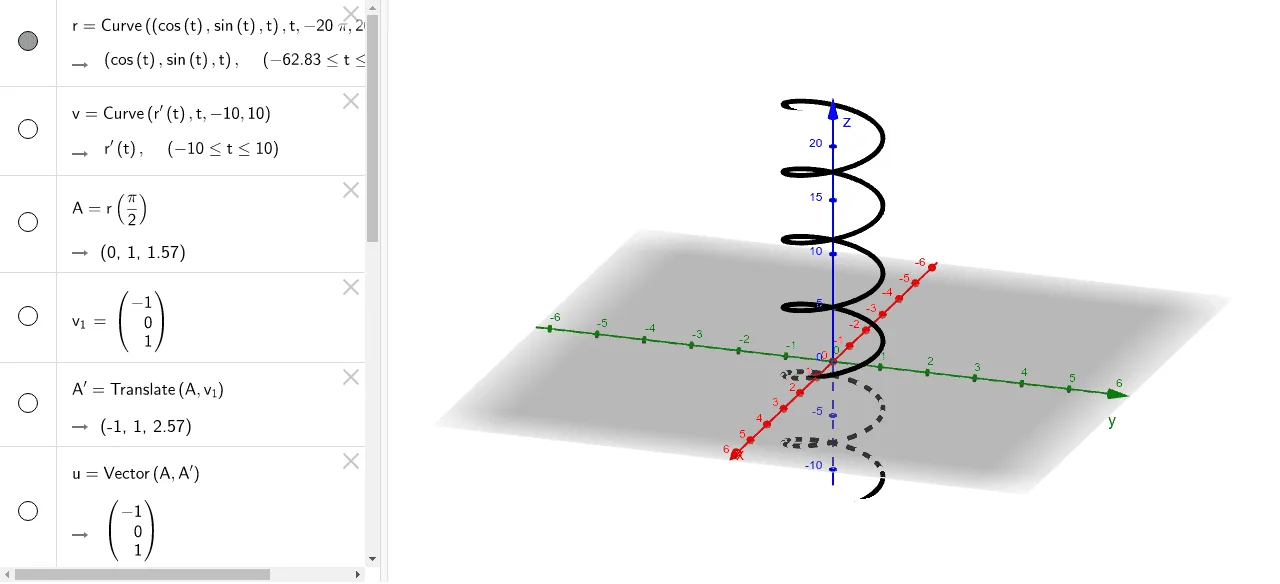
This example demonstrates the geometric shape and calculation of a helix and its derivatives. Core mathematical concepts include derivatives, analytical geometry, vector operations, and parametric equations. It utilizes GeoGebra commands and objects like CurveCartesian, Translate, Vector, Line, and elements such as r, v, A, v₁, A', u, B, w, B', a, s, k, C, f. Suitable for high school and above students studying calculus, solid geometry, and vector analysis, helping them understand the properties and dynamic changes of the derivatives of spatial curves.
GeoGebra Commands & Parameters
CurveCartesian((cos(t), sin(t), t), t, (-20 * π), (20 * π)) → rCurveCartesian(r'(t), t, -10, 10) → vTranslate(A, v_{1}) → A'Vector(A, A') → uTranslate(B, w) → B'Vector(B, B') → aCurveCartesian((t, 1 / t, 1 / (t - 4)), t, -10, 10) → sLine(A, A') → f
AI Drawing Prompt Reference
Draw a helix shape, described by parametric equations. The helix intersects a straight line, and points on the line form vector relationships with helix points. Points on the helix are connected to points on another curve via vectors. The construction order starts with the helix, then adds the line, and finally connects other curve points.
The prompt above was compiled from the original drawing commands and is for reference only.