
Probability in a Box
Loading the math board and drawing, please wait…
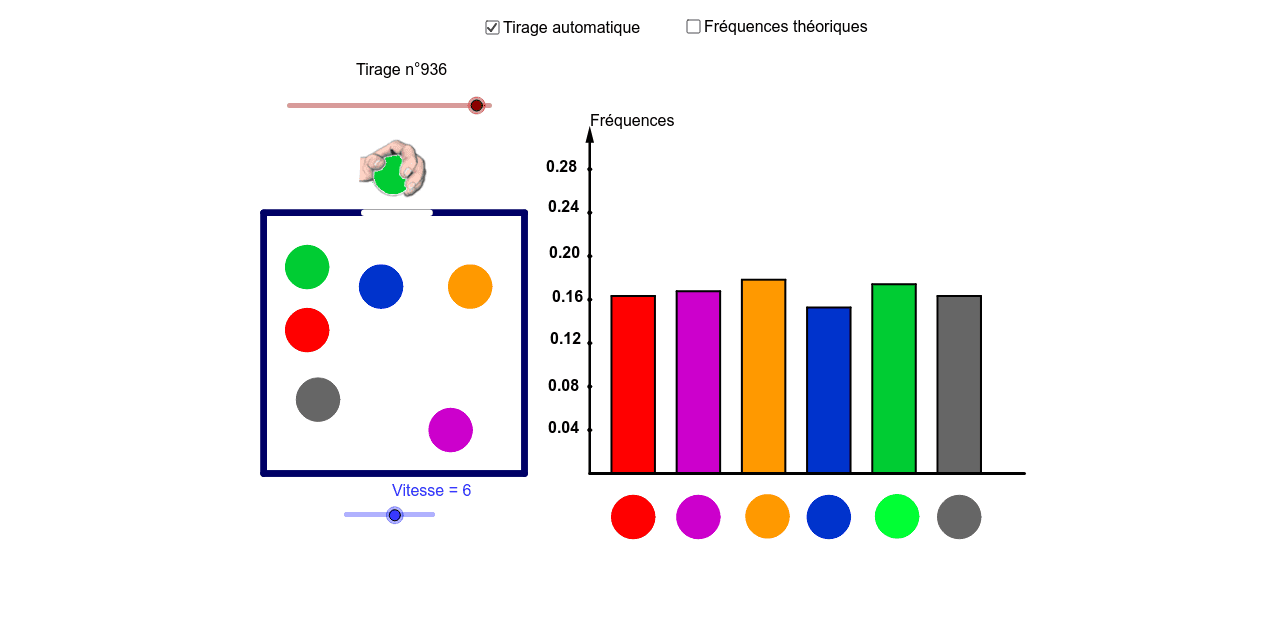
This example uses animations to demonstrate probability problems in a box. It involves core concepts of probability and statistics, dynamically showing the occurrence of probability events through GeoGebra commands such as Polygon, Circle, Sequence, etc. Suitable for high school mathematics teaching, particularly in probability and statistics courses.
GeoGebra Commands & Parameters
Polygon(E, F, 4.0) → poly1, e_1, f_1, h, i, G, HCircle(C, 1.0) → k_1Circle(A, 1.0) → pCircle(AA, 1.0) → tCircle(I, 1.0) → c_1Circle(M, 1.0) → d_1Circle(J, 1.0) → g_1Sequence(Random[1.0, 6.0], i, 1.0, 1000.0) → liste1First(liste1, n) → TirageCountIf(x ≟ 1.0, Tirage) → B3CountIf(x ≟ 2.0, Tirage) → B4CountIf(x ≟ 3.0, Tirage) → B5CountIf(x ≟ 4.0, Tirage) → B6CountIf(x ≟ 5.0, Tirage) → B7CountIf(x ≟ 6.0, Tirage) → B8Element(liste1, n) → ddCircle(O, 1.0) → eCircle(O, 1.0) → fCircle(O, 1.0) → gCircle(O, 1.0) → qCircle(O, 1.0) → rCircle(O, 1.0) → sPoint(h) → PPoint(h) → QSegment(P, Q) → jSegment(R, S) → mSegment(R, T) → a_1Point(m) → UPoint(m) → VPoint(m) → WPoint(m) → ZPoint(m) → A_1Point(m) → B_1Point(m) → C_1Point(m) → D_1Point(m) → E_1Point(m) → F_1Polygon(U, V, I_1, G_1) → poly2, u, v, i_1, g_2Polygon(W, J_1, K_1, Z) → poly3, w, j_1, k_2, zPolygon(A_1, B_1, M_1, L_1) → poly4, a_2, b_1, m_1, l_1Polygon(N_1, O_1, D_1, C_1) → poly5, n_1, o_1, d_2, c_2Point(m) → P_1Point(m) → Q_1Polygon(E_1, F_1, S_1, R_1) → poly6, e_2, f_2, s_1, r_1Polygon(P_1, Q_1, U_1, T_1) → poly7, p_1, q_1, u_1, t_1Point(a_1) → H_1Point(a_1) → V_1Point(a_1) → W_1Point(a_1) → Z_1Point(a_1) → A_2Point(a_1) → B_2Point(a_1) → C_2Vector(R, T) → v_1Polygon(P_1, D_2, F_2, Q_1) → poly8, p_2, d_3, f_3, q_2Polygon(H_2, G_2, F_1, E_1) → poly9, h_2, g_3, f_4, e_3Polygon(J_2, I_2, D_1, C_1) → poly10, j_2, i_2, d_4, c_3Polygon(L_2, K_2, B_1, A_1) → poly11, l_2, k_3, b_2, a_3Polygon(N_2, M_2, Z, W) → poly12, n_2, m_2, z_1, w_1Polygon(P_2, O_2, V, U) → poly13, p_3, o_2, v_2, u_2Circle(Q_2, 1.0) → h_1Circle(R_2, 1.0) → r_2Circle(S_2, 1.0) → s_2Circle(T_2, 1.0) → t_2Circle(U_2, 1.0) → h_3Circle(V_2, 1.0) → q_3