
Probability and Integral Calculation of a Ball Passing Through a Triangle
Loading the math board and drawing, please wait…
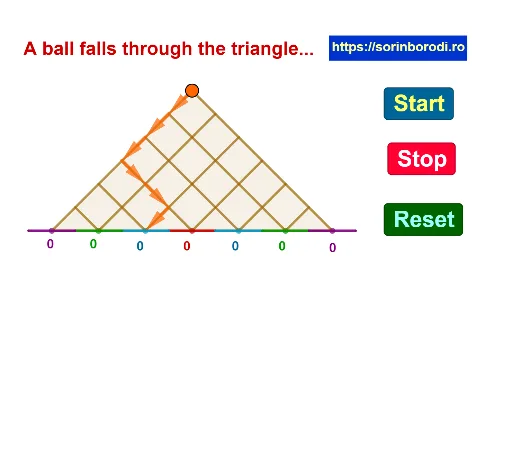
This example demonstrates the process of a ball passing through a triangular region and calculates its probability, involving core mathematical concepts such as Probability & Statistics, Logarithm, Integral Calculus, Optimization Problems, Difference and Slope, and Square. It is constructed using GeoGebra commands like Vector, Point, Circle, OrthogonalLine, Intersect, Segment, Polygon, and Line. Suitable for high school and above students learning calculus, probability statistics, and geometric construction.
GeoGebra Commands & Parameters
Vector(A, B) → uVector(B, C) → vVector(C, D) → wVector(D, E) → aVector(E, F) → bVector(F, G) → cPoint(xAxis) → HPoint(xAxis) → IPoint(xAxis) → JPoint(xAxis) → KPoint(xAxis) → LPoint(xAxis) → MPoint(xAxis) → NCircle(H, r1) → dCircle(I, r2) → eCircle(J, r3) → gCircle(K, r4) → hCircle(L, r5) → kCircle(M, r6) → pCircle(N, r7) → qOrthogonalLine(H, xAxis) → iOrthogonalLine(I, xAxis) → jOrthogonalLine(J, xAxis) → lOrthogonalLine(K, xAxis) → mOrthogonalLine(L, xAxis) → n_1OrthogonalLine(M, xAxis) → rOrthogonalLine(N, xAxis) → sIntersect(d, i, 1) → OSegment(H, O) → tIntersect(e, j, 1) → PSegment(I, P) → f_1Intersect(g, l, 1) → QSegment(J, Q) → g_1Intersect(h, m, 1) → RSegment(K, R) → h_1Intersect(k, n_1, 1) → SSegment(L, S) → i_1Intersect(p, r, 1) → TSegment(M, T) → j_1Intersect(q, s, 1) → USegment(N, U) → k_1Polygon(V, W, Z) → t8, z_1, v_1, w_1Point(v_1) → A_1Point(v_1) → B_1Point(v_1) → C_1Point(v_1) → D_1Point(v_1) → E_1Line(A_1, z_1) → m_1Line(B_1, z_1) → p_1Line(C_1, z_1) → q_1Line(D_1, z_1) → r_1Line(E_1, z_1) → s_1Line(E_1, w_1) → t_1Line(D_1, w_1) → a_1Line(C_1, w_1) → b_1Line(B_1, w_1) → c_1Line(A_1, w_1) → d_1Intersect(m_1, w_1) → F_1Segment(A_1, F_1) → e_1Intersect(p_1, w_1) → G_1Segment(B_1, G_1) → f_2Intersect(q_1, w_1) → H_1Segment(C_1, H_1) → g_2Intersect(r_1, w_1) → I_1Segment(D_1, I_1) → h_2Intersect(s_1, w_1) → J_1Segment(E_1, J_1) → i_2Intersect(t_1, z_1) → K_1Segment(E_1, K_1) → j_2Intersect(a_1, z_1) → L_1Segment(D_1, L_1) → k_2Intersect(b_1, z_1) → M_1Segment(C_1, M_1) → l_2Intersect(c_1, z_1) → N_1Segment(B_1, N_1) → m_2Intersect(d_1, z_1) → O_1Segment(A_1, O_1) → n_2Line(P_1, Q_1) → p_2Line(R, p_2) → q_2Point(p_2) → R_1Point(p_2) → S_1Point(p_2) → T_1Point(p_2) → U_1Point(p_2) → V_1Point(p_2) → W_1OrthogonalLine(T_1, p_2) → r_2OrthogonalLine(U_1, p_2) → s_2OrthogonalLine(R_1, p_2) → t_2OrthogonalLine(S_1, p_2) → a_2OrthogonalLine(V_1, p_2) → b_2OrthogonalLine(W_1, p_2) → c_2Point(p_2) → Z_1Point(p_2) → A_2OrthogonalLine(Z_1, p_2) → d_2OrthogonalLine(A_2, p_2) → e_2Intersect(q_2, t_2) → B_2Intersect(q_2, a_2) → C_2Polygon(B_2, C_2, S_1, R_1) → q1, f_3, g_3, h_3, i_3Line(Q, p_2) → j_3Intersect(s_2, j_3) → D_2Intersect(t_2, j_3) → E_2Polygon(D_2, E_2, R_1, U_1) → q2, k_3, l_3, m_3, u_1Line(S, p_2) → n_3Intersect(a_2, n_3) → F_2Intersect(b_2, n_3) → G_2Polygon(F_2, G_2, V_1, S_1) → q3, p_3, q_3, r_3, s_3Line(P, p_2) → t_3Intersect(t_3, r_2) → H_2Intersect(t_3, s_2) → I_2Polygon(H_2, I_2, U_1, T_1) → q4, a_3, b_3, c_3, d_3Line(T, p_2) → e_3Intersect(b_2, e_3) → J_2Intersect(c_2, e_3) → K_2Polygon(J_2, K_2, W_1, V_1) → q5, f_4, g_4, h_4, i_4Line(O, p_2) → j_4Intersect(d_2, j_4) → L_2Intersect(r_2, j_4) → M_2Polygon(L_2, M_2, T_1, Z_1) → q6, k_4, l_4, m_4, n_4Line(U, p_2) → p_4Intersect(c_2, p_4) → N_2Intersect(e_2, p_4) → O_2Polygon(N_2, O_2, A_2, W_1) → q7, q_4, o_2, r_4, s_4