
Prism Surface Area and Net: GeoGebra Solid Geometry Demo
Loading the math board and drawing, please wait…
In collections
Surface Area
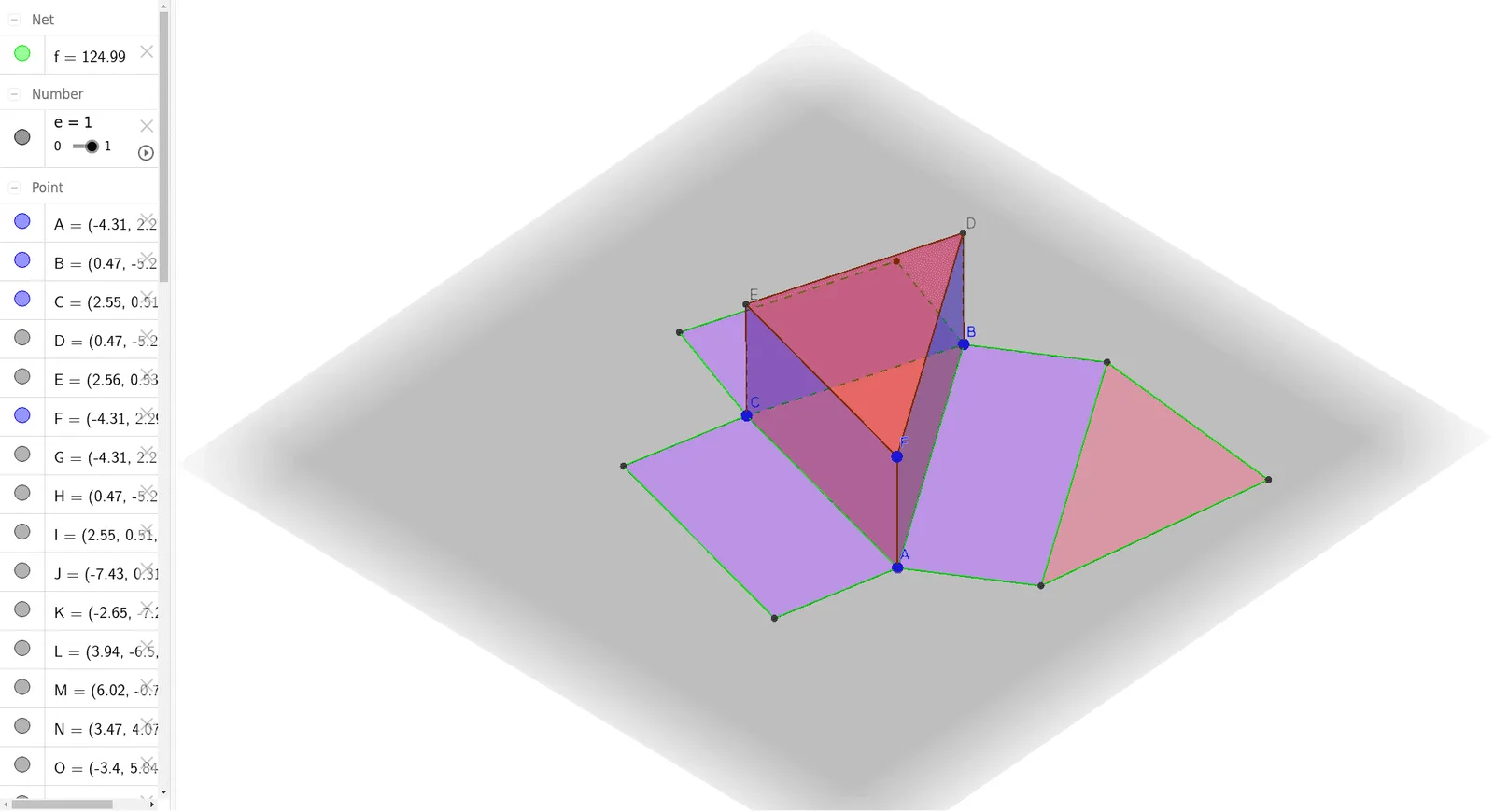
This GeoGebra example constructs a triangular prism and dynamically demonstrates its surface area calculation and the generation of its net (unfolded 2D pattern). The core mathematical concepts include the geometric structure of a prism, the surface area formula (sum of base areas and lateral faces), and the correspondence between a 3D solid and its 2D net. Construction highlights: using the Polygon command to create the base triangle (points A, B, C), the Prism command to generate the 3D solid, and the Net command to unfold it; multiple faces (faceABDF, faceBCED, faceACEF, faceDEF) and edges (edgeAF, edgeBD, edgeCE, etc.) are defined to visualize each component. This example is suitable for middle school (upper grades) and high school students learning solid geometry, surface area computation, and spatial visualization skills. It can be used for classroom demonstrations or student self-exploration of prism unfolding and folding.
GeoGebra Commands & Parameters
Polygon(A, B, C) → poly1, c, a, bPrism(poly1, F) → d, D, edgeDF, edgeDE, edgeEF, E, faceABDF, faceBCED, faceACEF, faceDEF, edgeAF, edgeBD, edgeCENet(d, e) → f, G, P, faceGHI, faceGHKJ, faceHIML, faceGINO, faceJKP, edgeGH, edgeHI, edgeGI, edgeGJ, H, edgeJK, edgeHK, edgeHL, edgeLM, edgeIM, edgeIN, edgeNO, edgeGO, edgeKP, edgeJP, I, J, K, L, M, N, O